Courses
This most ancient and fascinating of intellectual disciplines is fundamental to our understanding of what it is to be human.
Philosophy is an ancient discipline which studies the most fundamental questions that arise in all areas of human concern, from religion and politics, to morality and the sciences.
In studying philosophy at Durham, you will learn as much about how to think about difficult questions, as you will learn about the answers that can be given to them. You will be equipped for life with an ability to detect bad argument, whether in politics, in the media, or in discussion with the people you live and work with, and an ability to produce better arguments of your own.
Click on the course in which you are interested to see the programme structure. Please note that this information may change as courses develop and you should therefore treat it as a guide to the typical pattern of the programme rather than a definitive statement of what you will study.
Course |
Degree |
UCAS code |
Length |
Typical offer |
|---|---|---|---|---|
| Philosophy | BA (Hons) | V500 | 3 yrs | AAA |
| Philosophy and Politics | BA (Hons) | LV25 | 3 yrs | AAA |
| Philosophy and Psychology | BA (Hons) | CV85 | 3 yrs | AAA |
| Philosophy and Theology | BA (Hons) | VV56 | 3 yrs | AAA |
| English Literature and Philosophy | BA (Hons) | QV35 | 3 yrs | A*AA |
| Education Studies and Philosophy | BA (Hons) | XV35 | 3 yrs | AAB |
| Philosophy, Politics and Economics (PPE) | BA (Hons) | VL52 | 3 yrs | A*AA |
| Combined Honours in Arts | BA (Hons) | QRV0 | Varies | A*AA |
| Combined Honours in Social Sciences | BA (Hons) | LMV0 | Varies | A*AA |
| Natural Sciences |
BSc (Hons) |
CFG0 FGC0 |
Varies | A*AA |
Contact Dr Andy Hamilton, Admissions Tutor at philosophy.department@durham.ac.uk
Department of Philosophy home page
Philosophers ask questions about assumptions which most people, including thinkers in other disciplines, take for granted. For example, what is the nature of external reality and can we know about it? What is a person? Do human persons have free will and does it make sense to hold them responsible for their actions? Does the idea of a creative God, or an interventionist God, make sense? What is truth? How is it related to meaning? Is there only one true morality?
Philosophical questions such as these are fascinating but vexing and in joining the philosophical task of trying to answer them, you will become part of a tradition which goes back to Plato and Aristotle, to Heraclitus and beyond – to mention only the Western tradition.
The study of philosophy at Durham does not follow one particular school – the department has expertise in Anglo-American analytical philosophy and also, unusually in the UK, in Continental philosophy, with its distinctive set of issues and approaches to resolving them.
Course content
At Durham, you will have the opportunity to study philosophy as a Single Honours degree, or with another subject such as English, Psychology, Politics or Theology. Philosophy can also be combined in a Joint Honours degree within the Natural Sciences programme or as part of a Combined Honours degree.
We are fortunate to have expertise in the history and philosophy of science and medicine and you may take general introductory courses in either (or both) of these subjects in your first year. The study of the history of science involves looking at the development of science as the accepted way of explaining events in the natural world and considering it critically as a belief system in relation to other belief systems and dogmas. The study of the philosophy of science involves raising philosophical questions about scientific method and about the various metaphysical assumptions upon which scientific theories depend.
Philosophy is a new subject for most students, so in your first year you will follow a range of introductory courses, introducing the fundamental philosophical subject areas: metaphysics, the study of the nature of things; epistemology, the study of the nature and support of knowledge; ethics, the study of moral theories and moral problems; and logic, the study of formal systems which attempt to capture the essential structure of reasoning.
You may also follow a course in reading philosophy, which involves the close study of two or three classic short philosophical texts. You will go over these with a fine-toothed comb, studying the arguments, analysing the philosophical project of the text as a whole and assessing its results.
In the second and third years, you will have a choice of a wide range of topics including: Moral Theory, Philosophy of Mind, Aesthetics, Philosophy of Language, Philosophy of Religion, Political Philosophy, Metaphysics, Twentieth Century European Philosophy, Science and Religion in the Nineteenth Century, Applied Ethics, History and Philosophy of Science and Ethical Issues in the History of Medicine. You will also have the opportunity to study a subject in depth, by writing a substantial dissertation of your choice.
Teaching, learning and assessment
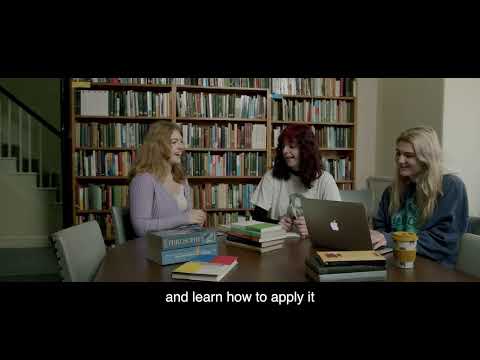
You will benefit from a range of teaching and learning techniques, focusing on lectures to outline the basic ideas and topics for seminar discussions and private study. We place a special emphasis on participation in tutorials and seminars, as philosophy is a subject that demands active engagement and discussion to assess ideas and to keep the subject fresh. You will also learn through personal study, essay writing and the researching and writing of your dissertation on a subject of particular interest to you.
In the first year assessment is based on a combination of essays and formal examinations. In subsequent years assessment is mostly exam based, though some courses also use continuous assessment.
Open days and visits
There are post-application open days in January and March for those who have received an offer. You will receive an invitation to attend one of these from your college. We also hold a series of pre-application Visitor Days from April to August. Please contact us for details.
In addition, the University runs campus tours every Wednesday. Further information and to book a place online.