This document describes the documentary and physical evidence that I have collected on the history of Tudhoe Village. Tudhoe is now a farming village near Spennymoor, about 5 miles south of the City of Durham (in the north-east of England).
Note: at the request of Durham County Record Office, all copies
of documents in their collections have been removed from this page.
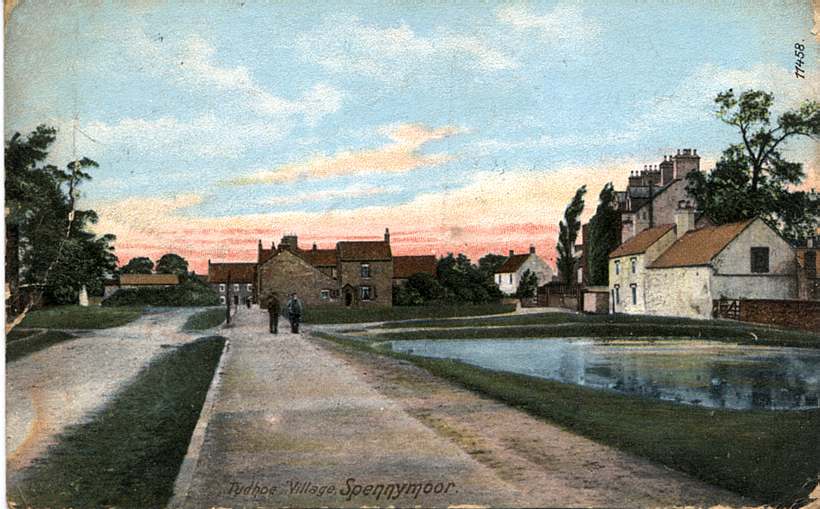
Tudhoe Village on a postcard from ca. 1900...
and the same view in 2001
The present account focusses on the period up to 1770. I have tried to set Tudhoe's history in a wider context; where possible, I have tried to describe how Tudhoe people were involved in local and national events. For Tudhoe itself, I have worked mostly from original documents (deeds, rentals, wills, court records, tax records, etc.). However, for the wider context I have drawn extensively on published histories - and, even for Tudhoe, I have taken information from earlier histories where necessary and references from anywhere I could find them.
My original interest was in Tudhoe Hall, which is the
oldest surviving building in the village (mostly 17th century).
However, the study has now spread much wider than that.
Tudhoe Hall and its barns from the south-east ... and the Hall from
the north-east
This is still a work in progress, and there are places where all I have are notes of topics still to investigate.
Introduction
Earlier Histories
Village Plan
The Manor of Tudhowe, 1200-1565
The Rebellion in the North, 1569
The growth of private ownership, 1570-1641
Recusancy in Tudor and Stuart Tudhoe
The Civil War and Commonwealth, 1642-1660
The Salvins of Tudhoe, 1665-1756
Maps of the area are available from www.multimap.com at scales of 1:200000, 1:50000, and 1:25000.
Tudhoe Village is now dwarfed by Spennymoor, an industrial town that grew up around the Tudhoe iron works in the 19th century. Historically, Spenny Moor was a vast common of scrub land that lay between and was shared by the villagers of Tudhoe, Merrington, Sunderland Bridge and Hett. The modern town of Spennymoor lies only a few fields from Tudhoe, but the contours are such that it cannot be seen from most of the village, and Tudhoe today gives the impression that it is still an isolated country village.
For most of its history, Tudhoe has been in the parish of Brancepeth. The parish church of St. Brandon's, dating from the 16th century, was one of the finest village churches in County Durham until its destruction by fire in 1998. Brancepeth lies across the River Wear from Tudhoe; there has never been a bridge, and the ford was not an easy one. In winter, it was often impassable, and Tudhoe baptisms, weddings and burials then took place at Whitworth. Because of this, Tudhoe was always seen (from Brancepeth) as an isolated outpost. Tudhoe's own Anglican churches, Holy Innocents and St. David's, were not built until 1866 and 1880, respectively, though there is a large Catholic church, dedicated to St. Charles Borromeo, which was founded in 1858.
Tudhoe receives scant coverage in the standard histories of County Durham. Hutchinson's History and Antiquities of the County Palatine of Durham (1785-94) includes just a few lines about Tudhoe (in the section on Whitworth). Tudhoe is not described in R. Surtees' great History and Antiquities of the County Palatine of Durham, published between 1816 and 1840, which is the most comprehensive source available for most of the rest of County Durham: Surtees died before he finished his coverage of Darlington Ward. H. Conyers Surtees tried to fill the gap in R. Surtees' coverage with his Parish Histories in 1919-29, and his pamphlet History of the Parishes of Tudhoe and Sunnybrow (1925) contains useful original information. J. J. Dodd published an anecdotal and entertaining History of the Urban District of Spennymoor (1897), but he seldom quoted his sources and his information is often unreliable. Dodd took much of his material on the earlier history of the district verbatim from other printed sources, including R. Surtees and a pamphlet by John Tate entitled The Early History of Spennymoor. A later book by J. Reavley on The History of Spennymoor (1935) is based closely on Dodd, again mostly verbatim. More recently, Tony Coia published an excellent but brief account entitled Tudhoe St Charles Parish 1858-1983 .
Almost the only published first-hand account of Tudhoe before 1800 is that by Charles Waterton, the eccentric 19th-century naturalist. Writing in 1862, he described four years he spent at a newly-established Catholic school in Tudhoe, from 1792 to 1796, when Waterton was 9-13 years old. This account is quoted extensively by Dodd, but I have not yet found the original source; it is not from Waterton's Essays on Natural History with a Life of the Author, 1st series (Longman, 1845).
The extensive series of publications of the Surtees Society, which began in 1835 and still continues, provides printed versions of many important documents.
The village green in Tudhoe runs from the north west to the south east. However, documents before ca. 1770 are consistent in describing directions as though it ran from north to south, and this is the convention adopted here. The rows of houses on either side are sometimes described in old documents as the East and West Rawes (Rows). The green is now about 760 yards long and from 40 to 70 yards wide. It may have been extended to the south at some time. The green used to widen into a pasture at its southern end: this may have been a "cattle drift", intended to funnel stock kept on the ancient waste of Spenny Moor into the village.
The earliest good-quality map of Tudhoe is the Tithe Apportionment Plan of 1839. The village then retained much of the mediaeval field pattern: in early times, each farmstead will have consisted of a long strip of land, leading back from a fairly even building line. In 1839, the strips to the east of the green were mostly about 330 yards long, though some were only 170 yards long and a few others had a boundary at about this distance. This is probably the remnant of the division between toft and croft: the toft was the house-plot itself, and the croft was an additional piece of private land that was usually used for vegetables or grazing. The tofts and crofts to the west ran down to the "far burn", 230 to 460 yards from the edge of the green. They are broken by another stream, the "hither burn", about half way along their lengths, but all the 1839 field names applied to land on both sides of the stream. Several of the west frontages are 1, 2 or 3 times a common multiple of 83 feet (perhaps five 16.5-foot rods). The boundaries on the east had been altered more by 1839, but several tofts seem to have been around 234 feet wide, which is somewhat less than 15 rods.
By far the widest plot in 1839 was the Hall Croft, near the centre of the west row; it is not clear whether it was subdivided in earlier times. Aerial photographs might help to establish this. There is a large stone house named Tudhoe Hall, dating from 1600 or earlier, near the southern end of Hall Croft. In 1839, there was a small enclosure named Bull Garth along the edge of the green to the north of the Hall; in earlier times, it was common for villages to keep a communal bull, and perhaps this is where it was kept.
There were some interesting field names in 1839. In particular, one plot lying on the east side of the village was called Ratten Row: one meaning of this is a roundabout way used to carry corpses for burial. There was (and is) a footpath towards Hett along the northern edge of Ratten Row, leading to (and between) Litch Close and Litch Field: litch is an Anglo-Saxon word for corpse (which survives in lych-gate, a covered gate into a churchyard where the bearers would wait before proceeding to the grave-side). The name Ratten Rawe was in use in Tudhoe at least as early as 1570. This suggests either that the villagers used a church other than Brancepeth or Whitworth in mediaeval times, or perhaps that there were burial grounds close to the village.
Mediaeval Tudhoe had three common fields, known as the west field, middle field and east field. The usual system in feudal times was that each tenant (bondman) cultivated individual strips of about half an acre, known as riggs, in each of the town fields. Because the soil was always ploughed inwards towards the centre, the land developed a corrugated profile, known as ridge and furrow (or, locally, rigg and furr). The riggs were grouped into larger units called flatts, with each tenant cultivating the same area of land (a virgate, often 24 acres) made up of one rigg in each flatt. The flatts were in turn grouped into fields. This system ensured a reasonably fair division of the high-quality and low-quality land.
In Tudhoe, the common fields lasted until 1639, when they were largely enclosed and divided among the freeholders. By then the individual holdings were of far from equal size. The enclosure award specifies the area allocated to each freeholder, and the names of the landowners to the north, south, east and west. The resulting jigsaw can be pieced together plausibly using the field boundaries from 1839; it appears from this that the west and middle fields lay to the north of the village, on either side of the Brancepeth road. I have not yet reliably located the east field, but it was probably beyond the crofts on the east side of the village.
The total area of common land partitioned up in 1639 was 450 acres. The original village probably had about 16 bondmen, each holding a tenement and cultivating 24 acres in the common fields. This would give 376 acres in cultivation. The remaining 74 acres of common land might indicate one or two extra tenements, but could equally plausibly have been uncultivated headlands and baulks between the cultivated strips.
The village will also have had other common lands, used as pasture (mostly for oxen) and meadow (to grow hay for winter fodder). The "town pastures" were mentioned in a survey of 1607, but they appear to have been divided up and allocated to individuals even before the 1639 enclosure: there were several "high pastures" that seem to have been in individual tenure by then.
A second major enclosure award, in 1669, divided up the common lands on Spenny Moor, to the south of the village (D/Sa/E 571).
In the early mediaeval period, the main tenants will have been bondmen, who were obliged to work on the lord's land for a specified number of days per week as well as paying money rents. In Tudhoe, this system may have persisted quite late: there were several closes (enclosed areas) that were named in 1570 as being in the tenure of the bailiff, Ralph Watson. The bailiff was the local land manager for the lord of the manor, in this case the Earl of Westmorland.
The only "ridge and furrow" now remaining is in Cow Plantation, west of the village, which was called Middle White Flatt in 1839. This is an interesting survival of the mediaeval naming system: in 1570, the White Flatt was one of the closes occupied by the bailiff. Nevertheless, local farmers say that several other fields had "rigg and furr" until quite recently. [A large area to the west and north of the village was obliterated by open-cast coal mining in the 1960s].
The earliest documents to mention Tudhoe come from the reign of King John: around 1200 Emma de Bulmer, daughter of the Lord of Brancepeth and widow of Geoffrey de Neville, granted the whole of Tudhoe village to Robert fitz Meldred, Lord of Raby, who had married Emma's daughter Isabella. This began a long-lasting association of the village with the Nevilles, who were to become the richest and most powerful family in the North of England during the 14th and 15th centuries.
Tudhoe may or may not have remained in Neville ownership, but it is next recorded in 1264, during the Barons' War, when Simon de Montfort led the rebellion against King Henry III that led indirectly to the establishment of the English Parliament. Sir Hugh Gubyon of Tudhoe was among 15 Royalist knights who were taken prisoner by Roger Mortimer's army at Northampton. Sir Hugh must have been released: he fought for the King again at the Battle of Lewes in 1265, where the King himself and his son Edward were taken prisoner. However, Simon de Montfort's triumph was short-lived: Prince Edward escaped, raised another army, and was victorious at the Battle of Evesham, where Simon de Montfort was killed. It is not clear what part Sir Hugh Gubyon played in these later events, but he is recorded as Lord of Tudhoe in an agreement with Richard de Hoton, Prior of Durham, dated 1279, described by Surtees (vol. 3, p. 279): Sir Hugh granted that the Prior's tenants of Merrington could retain certain areas of Spenny Moor that they had started to farm, and in return the Prior allowed Sir Hugh to divert the Tudhoe mill race "into its ancient channel". Sir Hugh was Sherriff and Keeper of Newcastle upon Tyne in 1292-4, and is recorded again as Lord of Tudhow in 1303: however, some of these references could of course be to a son of the same name. Sir Hugh's coat of arms was "barry argent and gules, a label of five points azure".
[The references to Hugh Gubyon as Lord of Tudhoe are interesting: the title implies that he was the tenant-in-chief and held it directly from the King (or Bishop), not from the Nevilles. A confusing factor in some ancient documents is the similarity between the names of Tudhoe (anciently Tudhowe) and Duddo (anciently Dudhowe). There are two places called Duddo in Northumberland, one of which is about 10 miles north of Newcastle. About 2 miles outside it is a place called The Gubeon. Gubyon and Gubeon references are very rare: all those on the Web refer either to the place near Duddo or to Gubyon Avenue in Herne Hill, London. However, the references to Merrington and Spenny Moor confirm that Sir Hugh Gubyon is associated with Tudhoe rather than Duddo.]
The major events of the 14th century must have left their mark on Tudhoe. This was the period of the Hundred Years War with France: Scottish raids were frequent, and alliances between Scotland and France came and went. In 1346, the English under King Edward III won the great Battle of Crecy in France. Immediately afterwards, King David II of Scotland took advantage of the absence of many of England's soldiers to invade. In fact, the North was well prepared, and the invasion culminated in a great Scottish defeat at the Battle of Neville's Cross, just outside Durham City, where King David was captured. On the morning of the battle, the Scots were encamped at Beaurepaire (Bearpark), which belonged to the Prior of Durham (they sacked it, and it has been a ruin ever since). The English army spent the night in Auckland Park, and moved on next morning to Merrington. A Scottish foraging party under William Douglas, Earl of Moray, unexpectedly encountered the English army at Ferryhill, a few miles south of Tudhoe: the Scots were pursued northwards up the Great North Road towards Sunderland Bridge, with the loss of 500 men. The route along which this massacre took place came be called Butcher Race; it passes less than a mile from Tudhoe.
Douglas advised King David to avoid battle, but his advice was ignored. The English army crossed the Wear at Sunderland Bridge and advanced to Neville's Cross. In the ensuing battle, the Scottish army was overwhelmed by English cavalry under Edward Baliol, and Kind David was captured by a Nothumbrian esquire named John de Coupland, supposedly under Aldin Grange bridge (over the River Browney, about a mile from Neville's Cross); tradition says that Coupland lost two teeth to King David's gauntlet. King David was ransomed the following year, for 100,000 marks, though the ransom was never paid.
The Black Death came to England in 1348-49, and killed almost half the population. It also brought peace to the border counties for many years. After the plague, the resulting labour shortages led to considerable changes in the relationships between lords and their feudal tenants: tenants were in demand, so they became more mobile, and could no longer be exploited as ruthlessly as before. Many villages shrank in size at this time, and some were abandoned, accounting for many of the "deserted mediaeval villages" found on maps today. It is not known what inroads the Black Death made in Tudhoe, but in other parts of the country the toll is known to have ranged from 20% to 80% of the population. The plague was to return at intervals for the next 150 years, and the population of Europe as a whole took 200 years to return to the level of 1340.
Tudhoe lay in the Bishopric of Durham. Within the Bishopric, the Bishop of Durham exercised most of the powers of the monarch. Indeed William de St. Botolph, the steward of Bishop Bek, could write in 1302, "There are two kings in England, namely the Lord King of England, wearing a crown in sign of his regality, and the Lord Bishop of Durham, wearing a mitre in place of a crown, in sign of his regality in the diocese of Durham."
There are scattered references to Tudhoe and its inhabitants in the 14th, 15th and 16th centuries in the Chancery Rolls, which record the business of the Bishop's court, and in Inquisitions post mortem, which record the lands held by "tenants in chief" when they died. These are described in detail in the Appendix. The earliest reference is to "one messuage and seventy acres of arable and pasture land", held by Matilda, widow of Thomas de Tesedale of Tudhowe and "her three partners" when she died in 1338. The lands are described as "held of the three lords who are partners in Tudhowe", so it is clear that Tudhoe was a manor in its own right at this time. The rent paid was 40s (quadraginta solidos) per annum
Tudhoe in the 14th century was a rural community, but it was not cut off from the outside world. People moved around, and various people living elsewhere are described as "of Tudhowe" in the Chancery Rolls. For example, in 1345, justices were appointed to inquire into a complaint made by John of the Castel, cook, and his wife Agnes, against Geoffrey Gray and Thomas de Tuddow of Durham; it was claimed that Geoffrey and Thomas had ridden over Agnes in the Bailey at Durham, causing her to have a miscarriage. Tudhoe even had international connections: in 1352, the Chancery Roll records that William de Beautrove, Adam Smyth of Tudhowe, William Barker of Tudhowe, William Todd of Tudhowe and Peter Igson acknowledged their obligations to Bonagius Pouch of Florence, described as a moneyer; presumably they owed him money. Beautrove is the old name for Butterby, now an isolated farm on the banks of the River Wear near Croxdale.
These were violent times. We can only wonder at the story behind a case in 1392, when Thomas de Elmeden, Thomas de Langton, William Langtonman, John de Bisshopton, Thomas Plungone and William Cowper of Helmeslay lay in ambush for John de Westwyk, clerk (priest), at "Bronwood on this side of Durham" and pursued him to Tudhoe, where they killed him. They were pardoned, which in those days probably implied that they had powerful friends rather than that they were innocent.
By 1400 or a little later, Tudhoe was certainly in the possession of the Nevilles, lords of Raby and Brancepeth and by then Earls of Westmorland. The manor of Tudhowe is listed explicitly in the Inquisition post mortem for Ralph, the 1st Earl, in 1425, and for his successors in 1484, 1498 and 1549. In 1498 it is described as "the manor and vill of Tudhow".
It is not clear whether the Nevilles' possession of the manor of Tudhoe was continuous from the time of Geoffrey de Neville. It is not mentioned in the 1367 Inquisition post mortem for Sir Ralph Neville, Lord of Raby, who had led part of the English army that defeated the Scots at the Battle of Nevilles Cross in 1346. Ralph Neville's son and heir was John Neville, who fought at both Crecy and Neville's Cross and in 1375 gave to Durham Cathedral the famous Neville Screen that still stands in the nave. John died in 1388, but Tudhoe is again not mentioned in his Inquisition post mortem. It was John Neville's son Ralph Neville who was created 1st Earl of Westmorland in 1398.
Probably the most important inhabitant of Tudhoe under the Nevilles was John Hoton. He held only "a messuage and five acres of arable land" in Tudhoe from Ralph, Earl of Westmorland "by fidelity and the service of rendering yearly one grain of corn". However, he also held substantial lands in his own right elsewhere: for example, in 1410 he acquired a share in the manors of West Brandon, Inesley and Roweley from Thomas de Redworth. In 1409 and 1414 he was among those appointed Commissioners of Array for the ward of Darlington. This was during the Hundred Years War with France, and the function of Commissioners of Array was to hold musters of all men of military age (16 to 60) and to select the fittest for military service. The musters for Darlington ward were probably held on Spenny Moor, close to Tudhoe, and must have been quite an event.
The names of John and Henry Hoton are listed among those who fought with King Henry V at the Battle of Agincourt on St. Crispin's Day, 25 October 1415; this could just be a coincidence of names, but since John Hoton was Commissioner of Array and a Henry Heton [sic] of Tuddowe is mentioned in Bishop Langley's Chancery Roll in 1412, it seems likely that these were indeed John and Henry Hoton of Tudhoe. Further credence is lent to this by the fact that John Hoton held the manor of Bromyholm from the Bishop of Durham "by foreign service".
John Hoton died in 1420, and was succeeded by his son William, who soon moved from Tudhoe to Hunwick (near Bishop Auckland). This William Hoton must not be confused with another of the same name, William Hoton of Herdwyk (Hardwick, near Sedgefield): they were related, but were sometimes both mentioned in the same document, so they cannot be the same person. In any case, neither of them lived in Tudhoe after 1426. However, John Hoton's widow Johanna survived until 1444, and it seems quite likely that she continued to live at Tudhoe.
In 1426, Sir William Eure of Woton, William Spence and William Hoton of Herdwyk were given custody of lands that included the manor of Tudhowe. This was just after the death of the 1st Earl of Westmorland; his son John was already dead, so the Earldom passed to his grandson Ralph, who was only 19 and thus under age. However, there seem to have been problems: the following year, a writ of scire facias (summons to appear at court) was issued against the three custodians, "for debt at the suit of the Lord Bishop".
In 1454, William Joy of Tudhowe, described as a "walker", was sentenced to death because he and Adam Hedley of Tudhowe, yeoman, had broken into the house of a widow named Margaret Neuland at Midelham and stolen "certain of her goods and chattels". However, Joy was pardoned by Bishop Neville at the request of Sir Thomas Nevile. Again, it would be nice to know why.
The Nevilles held the manor of Tudhoe, and presumably had tenants who farmed the land. However, the lands held by John Hoton and his heirs were evidently special (though perhaps just because the Hotons were "chief tenants" elsewhere). In any case, there seems to be a plausibly continuous chain through from John Hoton to John Thursby and thus William Iley, who appears as a "free tenant" in 1570 (see below).
John Hoton's lands probably descended as follows:
Johanna (or Jane) Whitworth = John Hoton of Tuddowe
d. 1444 | d. 1421
|
William Hoton of Hunwick
(1398-ca.1450)
|
|
Ralph Hoton
(d. ca. 1468)
|
|
John Hoton esquire Richard Hansert of Walworth
ca. 1454-1485 d. 1497
| |
| |
----------------- ------------------
| | | |
Johanna Elizabeth = William Hanshert Thomas
(1484- ) (1484- ) | d. 1520
|
William Haunsard
(1501-1522)
|
|
Sir Francis Ascugh = Elizabeth Hanserd of Walworth
d. 1565 (1522- )
(sold lands to John Thursby in 1557,
who sold them to William Iley in 1561)
A considerable amount is known about John Hoton Esq., and is excellently described by W. E. Hampton in John Hoton of Hunwick and Tudhoe, County Durham, The Ricardian, VII (1985), pp. 2-17. John lived during the Wars of the Roses, which were fought between the Plantagenet houses of York and Lancaster, and was firmly aligned with the Yorkists. In 1480, there was a large Scots raid, and King Edward IV appointed his brother Richard, Duke of Gloucester, as Lieutenant-General of the North to combat the threat. The Duke issued Commissions of Array for the northern counties, and John Hoton was one of the Commissioners for Durham. John Hoton was to serve under Gloucester for the rest of his life.
When Edward IV died in 1483, Gloucester was appointed protector of the 13-year-old Edward V, but chose instead to declare himself King, as Richard III, and imprison Edward and his younger brother in the Tower. These were the "Princes in the Tower", supposedly murdered by Richard. Gloucester surrounded himself with northerners: when he set out towards London after Edward's death in 1483, it was with "a competent number of gentlemen of the North, all clad in black". John Hoton was among them, and was with Gloucester throughout the brief but turbulent period of his Protectorate. John Hoton also played a prominent part in suppressing the rebellions in the south that followed Richard's coronation. By December 1483, Hoton had been appointed Esquire for the Body to Richard III, and was granted several manors in Hampshire previously held by Sir William Berkeley, who had been one of the rebels. Although Hoton retained his lands in the North, much of his subsequent work was in the south: for example, he was Commissioner of Array for Hampshire in 1484 and 1485 (as was Richard Hansard of Walworth). Hoton was also constable of Christchurch Castle, near Poole.
John Hoton probably died at the Battle of Bosworth Field, near Leicester, in August 1485, where Richard III was defeated by Henry Tudor, who then became King Henry VII. Richard himself died in the battle. John Hoton was buried in the chapel of Trinity College, Oxford (formerly Durham College). Unfortunately, his brass is no longer there.
A seven-page fragment of a manorial Court Roll for Brancepeth for 1492-3 is preserved in the Public Record Office at Kew (SC/171/2). It deals with a number of villages, including Tudhoe as well as Brancepeth itself, Crook, Willington, Stockley and Thornley. The names mentioned for Tudhoe include Robert and Richard Harryson, John Hunter and a few others.
The format of the Court Roll suggests that Tudhoe was administered as part of the manor of Brancepeth, although it was still listed separately as "the manor and vill of Tudhow" in the IPM for Ralph, the 3rd Earl of Westmorland, in 1498 and again in 1549 [check how]. However, may have been absorbed formally into Brancepeth in about 1560: the Nevilles still owned it, but it is not mentioned in the Inquisition for Henry, the 5th Earl of Westmorland, in 1564, and it was definitely considered to be part of Brancepeth by the time of Homberston's Survey in 1570 (see below).
1536-40: Dissolution of the monasteries. Did it have an impact on Tudhoe? Also the Pilgrimage of Grace.
Charles Neville, 6th Earl of Westmorland, inherited his father's earldom and lands, including Tudhoe, in 1564 at the age of 21. The first really detailed picture of Tudhoe comes from Homberston's Survey, which was taken after the Earl's downfall in 1570. The Survey makes it clear that by this time Tudhoe was regarded as part of the manor or Brancepeth, and indeed it is not listed specifically in the Inquisition post mortem taken for Henry, the 5th Earl, in 1564.
Homberston's Survey of the manor and lordship of Brancepeth begins: "In the view and survey of the castell and manors of Braunspeth and of all other manors, lands, tenements, graunges, colemynes, p'kes, chaces, rents, s'vices and of all other comodyties...". The original document is in the Public Record Office at Kew, reference E 164/37 (folios ff. 278-316).
Homberston's Survey is a beautifully written document, in Latin, listing all the Neville tenants in the manors of Raby and Brancepeth and giving a description of the lands held by each tenant. The Tudhoe section occupies four pages. With the exception of two small free tenants, John Cooke and William Iley, the villagers were all leaseholders who will have performed services for the lord of the manor as well as paid money rents. Their holdings and rents are listed in some detail. Those who held leases were:
William Hodgeson, gentleman 107s 2d
Henry Sidgwick 30s 6d
John Highe 29s 2d
William Whight 9s 2d
William Duckett 9s 2d
John Colman 4s 6d
Emmery Whetley 5s 6d
Richard Herryson 27s 2d
Emmery Richardson 15s 10d
Johanna Awlde 16s 6d
Ralph Watson 73s 2d ob
Ralph Byerley 19s 9d
John Sparke 19s 9d
William Bullock 10s
William Harryson 19s 9d
Henry Richardson 57s 8d
Humphrey Jackson 26s 6d
Emmery Whetley 7s 6d
In addition, Margareta Byers paid a rent of 8s 6d, but did not have a lease. Even the free tenants paid some rent: William Iley paid 6d, and John Cooke paid 6d and a pound of pepper; the pound of pepper keeps cropping up in later rentals, and it would be interesting to know how it originated!
A free tenant had several rights not possessed by the bondmen (who by 1570 had come to be known as husbandmen). A free tenant's rent was fixed in perpetuity, and he could sell his land. Because of the fixed rents, it is difficult to know how much land the free tenants held. However, both William Iley and John Wheatley (who had taken over John Cooke's holding and was now responsible for the pound of pepper) were identified in 1607 as living in cottages. They are therefore unlikely to have had substantial holdings.
A bondman's land in theory reverted to the lord of the manor when the tenant died. In practice, it usually passed to his son, who had to pay an "entry fine" for a new lease. When the feudal system was at its height, bondmen owed the lord much more than money rents: they worked the lord's land and performed many other services. Problems could thus arise if a man's widow was unable to meet the obligations. Under these circumstances, the tenement often passed to a relative who could meet the obligations, and who agreed to support the widow. However, towards the end of the feudal period, many of the feudal obligations were commuted to money rents, so this became less of a problem.
Most villages had cottagers as well as husbandmen; the cottagers did not have enough land to support them, so acted as labourers paid by the day. In Tudhoe, it seems likely that John Colman and Emery Whetley were cottagers, paying rents around 5s, whereas the standard rent for a farmstead was 19s 9d. The differences from this figure might arise from earlier land transfers or from the commuting of services into money rents. The tenants with rents around 9 or 10s are listed elsewhere as husbandmen, so probably held tenements that had been divided in two at some time. Ralph Watson, the bailiff, was a special case, but Henry Richardson was evidently particularly prosperous, with a holding three times the usual size.
One of the rights of the Lord of the Manor was to run the mill as a monopoly. His tenants were required to take their corn there to be ground, and to pay a "multure", perhaps of one thirteenth. They were not even allowed to grind the corn by hand themselves. In Tudhoe, the mill was located where the mill stream crossed the Whitworth road, and at the time of Homberston's Survey was run by John Highe. There will also probably have been a communal forge, a bread oven and a brewhouse in the village. Some of the cottagers may have made part of their living from such trades.
[In old currency, there were 12 pence (d) to a shilling, and 20 shillings (s) to a pound (` or li).]
Nearly all the leases listed in 1570 started in June or July 1565, perhaps a sign of the new Earl getting his paperwork in order. Exceptions to this are the leases for William Hodgson, dated 1561, Henry Richardson, dated 1558, and Ralph Watson, dated April 1565. It is noteworthy that these are the three largest tenants. Ralph Watson was the bailiff (estate manager) for Tudhoe, so it seems likely that he was appointed first and was responsible for organising leases for all the minor tenants. William Hodgeson, with the rank of "gentleman", is a special case: it seems likely that this was William Hodgson of Madenstedhall (Manor House, Lanchester), and that he did not live in Tudhoe at all, though the entry lists a messuage, or dwelling house. The total rent for the village came to `24 18s 3d and a pound of pepper, of which Ralph Watson received 60s 8d for his services as bailiff and woodward.
Most of the entries for Tudhoe are very similar, describing "a tenement with all lands, meadows, pastures, rights of pasture..." Exceptions are those for William Hodgeson (which specifically lists a messuage (dwelling house) instead of a tenement), John Highe (which mentions a water corn mill as well as the tenement) and Ralph Watson (which lists several pieces of land by name: Roger Close, White Flat, Calves Close, Thisterclose, Rattenrawes, Hunterclose). All these can be identified from field names in the 1839 Tithe Apportionment. The second entry for Emery Whetley specifically mentions 15 acres of arable land; this may have been an assart, or extra holding (perhaps on the outskirts of the village) that was not part of the common fields.
From matching with later documents and holdings, it seems likely that the list of leasehold tenants in Homberston's Survey is ordered geographically, running southwards up the East Row of the village and then back northwards down the West Row. William Hodgeson's house was probably near the site of the current Coldstream Farm, close to the river north of the village. However, all the rest of the tenants probably lived in the village itself; a tentative mapping of tenants to plots of land is shown in Figure 2. In addition to his or her own croft, each tenant will also have farmed a strip of land in each of the three "common fields", which lay to the north of the village, each side of the Brancepeth road.
Queen Elizabeth, who succeeded Queen Mary in 1558, was no religious zealot, and had no desire to enquire too closely into individuals' beliefs. Nevertheless, her claim to the throne was based on the validity of Henry VIII's marriage to Anne Boleyn. Since Henry's divorce of Catherine of Aragon was not recognised by Rome, strict Catholics held Elizabeth to be illegitimate. It was therefore politically essential for her to support the Church of England; nevertheless, she initially worked hard to avoid antagonising the Church in Rome, and insisted only that Catholics should attend occasional Anglican services and thus acknowledge her right to the throne. Those who refused even this concession might be charged with recusancy, for which the penalty was a small fine.
This tolerant state of affairs was disrupted in 1568, when Mary Stuart was deposed as Queen of Scots and fled to England. Her flight followed the murder of her husband, Lord Darnley, and her subsequent marriage to the earl of Bothwell, widely believed to be Darnley's murderer. Whatever her personal involvement in these events, Mary Stuart was a descendant of Henry VII through a line untainted by illegitemacy, and was thus the Catholic candidate for the English throne. She apparently hoped that Elizabeth would help her to regain her Scottish throne, but it was politically impossible for any such help to be offered. Elizabeth imprisoned her, though in some comfort.
In England, Mary Stuart quickly became the focus for those who wanted to restore Catholicism. Elizabeth refused to designate her heir, and attention focussed on the succession. One suggestion was that Mary should marry the powerful Duke of Norfolk: however, Elizabeth heard about the proposal, and forbade it. Meanwhile, the Catholic Earls of Westmorland, Charles Neville, and Northumberland, Thomas Percy, were planning a revolt in the North, possibly with the connivance and certainly with the knowledge of Norfolk (who was also the brother of Neville's wife Jane, Countess of Westmorland).
The security of the North of England was in the hands of the Council of the North, based at York. Its President was the Earl of Sussex. Further north, Newcastle, Berwick and Carlisle were strongly fortified cities. The City of Durham was less strongly fortified, but was of great importance as the seat of the Bishop of Durham and the centre of the Bishopric. Durham and Northumberland were sprinkled with castles, held either by local nobles (like Raby and Brancepeth) or by officers of the Queen (like Barnard Castle and Holy Island). The Scottish Borders were a wild and lawless area, with well-established families on both sides who supplemented their livelihood by raiding and sheep-stealing, taking advantage of the fact that neither the Scottish nor the English authorities could easily enforce the law on the other side of the border. These were the Border Reivers, of whom many tales are told. In administrative terms, the Borders were split into East, Middle and West Marches on either side, each under the care of a Warden. They operated under the Laws of the Marches, which provided for loose cooperation between the Wardens on the English and Scottish sides to enforce cross-border law at periodic Truce Days. In 1569, the Wardens of the East, Middle and West Marches were Lord Scrope of Castle Bolton, Sir John Forster and Henry Carey, Lord Hunsdon, who was also Governor of Berwick.
The Rebellion was conducted primarily from Brancepeth Castle, the Neville
stronghold just two miles from Tudhoe, though separated from it by the
River Wear. There was a ford, however, and communications must have
been good, because Tudhoe was now administratively part of the manor of
Brancepeth. Unfortunately for the Earls, rumours of their preparations
leaked out; they were ordered to appear before the Council of the North
(of which they were members), to explain themselves. When they did not
appear, they were ordered to "repair to the Queen's Majesty". By then
Norfolk was in the Tower of London, and the Earls decided to launch their
rebellion rather than follow him there. In a sequence of letters to the Earl
of Susses from 10 November onwards, Sir George Bowes tells of the preparations
for rebellion and the gathering in of the Earls' forces to Brancepeth.
On the night of 13 November 1569, church bells were rung backwards
throughout the Neville and Percy domains, and retainers of the Earls
toured the villages, intimidating their opponents and raising the populace.
Most of the men of Tudhoe joined the rebellion: they probably had little
choice, given the alliegance that they owed to the Earl of Westmorland.
Brancepeth Castle in the 18th century
The rebel Earls entered Durham on 14 November, with three hundred horse, "where they rent and trampled underfoot the English bibles and Books of Common Prayer". They celebrated Mass in the Cathedral and elsewhere, and issued a proclamation claiming that their intention was to restore the Catholic religion, but not to unseat Queen Elizabeth: "Forasmuch as divers and ill disposed persons about the Queen's majesty have, by their subtle and crafty dealing to advance themselves, overcome in this our realm the true and Catholic religion towards God; and by the same abused the Queen...". They then headed South, intending either to take York or to release Mary Stuart, who was by now confined at Tutbury, near Derby. Within a week they were camped outside York, at Tadcaster; Mary was hurriedly moved south to Coventry, arriving there on 25 November. |
The Earl of Sussex, in York, was loyal to the Queen but was powerless to act without reinforcements from the South. He was short of horsemen, and in any case was concerned that his own men would defect to the rebels if they had a chance. As he wrote to Sir William Cecil, Elizabeth's Secretary of State, on 20 November, "He is a rare bird that, by one means or another, hath not some of his with the two Earls, or in his heart wisheth not well to the cause they pretend." Unfortunately, Sussex himself was a case in point: his half-brother Egremont Ratcliffe was involved in the rebellion, and the Queen was suspicious of Sussex's own loyalty.
It would take some time to prepare an army and send it North, but the Queen dispatched her trusted advisor, Sir Ralph Sadler, to York; he arrived there on 24 November, accompanied by Lord Hunsdon, Warden of the East March. Sadler quickly wrote to the Queen to reassure her of Sussex's loyalty, and to support his view that confronting the rebels would be unwise. Sadler estimated the rebels' force at 1000 horse and 6000 foot; Sussex had less than half that number available. Sadler also commented revealingly to Cecil on 6 December (Sadler's State Papers, Vol. II, p. 55): "There be not in all this country ten gentlemen that do favour and allow of her Majesty's proceedings in the cause of religion...".
There was one powerful man in the Bishopric of Durham who remained loyal to the Queen and was prepared to fight: Sir George Bowes of Streatlam, warden of Barnard Castle, was a staunch Protestant and loyalist. The story of the Rebellion is graphically told in a series of letters he exchanged with the Earl of Sussex and others. (Memorials of the Rebellion of the Earls of Northumberland and Westmoreland, ed. C. Sharp, 1840). It is a tale of incompetence and mismanagement on both sides. The rebels failed to take advantage of their initial success, and the government in the South failed to provide the resources that Sussex needed to mount an effective opposition early on.
Some more on the early stages of the Rebellion needed here: a few sentences at most.
Eventually, as the southern army approached, the Rebellion simply petered out. Mary Stuart was now out of reach, and the Earls failed to press home their advantage; there was no assault on York. The rebels retreated northwards to the Bishopric, but once there failed to take any vigorous steps to increase their numbers; instead they wasted time beseigeing Sir George Bowes in Barnard Castle. When the seige was first set, on 1 December, Sir George had 700 or 800 men.
Sussex dared not march north to relieve Sir George until he was assured that the southern army under Lord Warwick and the Lord Admiral was at his back. He did not receive this assurance until 7 December, when he immediately set out northwards, writing to Sir George that "by the Queen's Majesty's special direction, I have tarried for my Lord of Warwick and my Lord Admiral, who will be at Boroughbridge on Saturday next, with 1200 horsemen, 500 harquebusiers, 500 pikes, 1000 archers and 4000 billmen."
At Barnard Castle, Sir George was in trouble. In addition to the usual problems of a siege, he suffered constant desertions and attempts by his own men to surrender the castle. In one day, 80 men leapt from the castle walls in an attempt to desert, and 35 of them broke their necks, legs or arms. The next night, 150 men detailed to guard the gates suddenly opened them and went over to the rebels (Sharp, p. 97-100). Eventually, on 12 December, the treachery of his men and shortage of food and water forced Sir George to abandon the castle. Remarkably, the Earls allowed him to march out, with his remaining 400 men and all their weapons, to meet up with Sussex, Hunsdon and Sadler at Topcliffe.
On 15 December, the Earls were still at Durham. However, on 16 December "they gave warning to the common people to make shift for themselves; and thereupon have themselves departed with a great number of horsemen westwards". The principal rebels fled to Hexham and then to the Borders. In the end, the Earl of Northumberland was tricked into crossing the border and was taken into custody by the Regent of Scoland. By the end of December, many of the others, including Jerrard Salvin of Croxdale (Sharp, p. 123), had been taken by Lord Scrope and were imprisoned at Carlisle.
In the aftermath of the Rebellion, Sir George Bowes was instructed to tour the countryside to conduct trials and executions. The Queen was most insistent in her demands for vengeance; she wanted no further Rebellions in the North, and she wished to ensure that the people were cowed. Sir George was instructed that at least one man should be executed, for an example, in every town from which anyone joined the Rebellion. However, the Queen also wanted reimbursement for her expenses: Sir George's instructions were that only those "of the meaner sort" should be executed; richer rebels could be fined instead. In three weeks of bitter January weather, Sir George made a circuit of Durham and Yorkshire, hearing cases and "appointing" men to be executed in every town and village that had provided men for the Rebellion; in the climate of the times, this must have been almost every village in the North-East. The lists (Sharp, p. 251) record that 10 men "of Tuddey" took part in the Rebellion, and 2 were appointed to be executed. All the executions were to take place in public, in the men's home towns, to act as an example to the survivors. This conjures up an image of a gallows set up on the Tudhoe village green, with the townsfolk gathered around to see their neighbours put to death.
Sharp's book gives only examples of the names of those appointed for execution, on p. 155. More details exist in the Bowes MSS themselves.
In reality, it seems likely that far fewer men were actually executed than the 700 that the lists suggest. Sir George was in a hurry, and it seems he had no stomach for ensuring that the executions he "appointed" actually took place. The Queen was clearly suspicious that this was so, and sent written questions for Sir George to answer. His answers look downright evasive; at every turn he is careful to refer to the numbers "appointed to be executed", and to point out that he did not supervise the executions and thus cannot guarantee the actual number carried out.
Those who were not executed were mostly pardoned, though a few escaped from the country or were banished. An Act of Attainder passed in 1571 outlawed 56 of the principal rebels. People who could not afford individual pardons were included in large numbers of "Group pardons" issued on 25 April 1570 and listed in the Calendar of Patent Rolls. Their general form is "Pardon for [names and ranks], for all treasons, rebellions and other offences committed between 1 Nov, 11 Elizabeth, and 31 Jan following. On report of their penitence for their part in the rebellion in the North, testified before commissioners of the Queen." Tudhoe names among the pardons include Henry Siggiswick (no. 872), Ralph Byerley (no. 873), Ralph Watson (no. 875), Henry Richardson, William Duckett, Humphrey Jackson, John Heigh, William Harrison, William Bullock and Robert Wheatley (no. 880). All these are listed as husbandmen except Ralph Watson (yeoman) and Robert Wheatley (labourer). This makes up 10 men of Tudhoe who were pardoned for rebellion, matching the number reported as taking part in Sharp's lists and throwing further doubt on the suggestion that anyone from Tudhoe was actually executed. However, it may be that some who were not significantly involved nevertheless thought it prudent to obtain pardons, so there remains a possibility that executions took place.
William Hodgson, who was the only "gentleman" listed in Tudhoe in Homberston's Survey, played quite a major part in the Rebellion. He was the fourth son of James Hodgson of Newcastle, and acquired the Manor of Madenstedhall (Manor House, Lanchester) in 1553. Towards the end of the Rebellion, when the army from the South had finally arrived, he was first in a list of those that Lord Hunsdon writes exasperatedly on 9 January 1569/70 had been "received into the protection of the Earl of Warwick and the Lord Admiral". Several of the names listed are the same as those in group pardon no. 796: "William Hogeson of Madenstedhall, yoman, William Claxton of Waterhouse, gentleman, Nicholas Fetherstonhaigh of Awkenshawe, Ralph Willie of Houghton, yoman, Martin Jackson of Hellmendenrawe, Christopher Shawe of Branspeth, yoman, Ralph Pickering of Mawde Medows, Rowland Wall of Willington, yoman, Ninian Watson of Sommerhouse, yoman, and Edward Marley of Engleston, all in the county of Durham." It is remarkable to note that, of the surnames in this list, we have already encountered Hodgson, Jackson and Watson, while Fetherstonhalgh, Willie and Pickering will all appear as Tudhoe landowners or residents during the next 100 years.
William Hodgson died in 1598, and his will has been published by the Surtees Society. It is clear that he felt responsible for the sufferings of some of his associates in the Rebellion: he left money to John Longstaff "in consideration of his losses he sustained by me in the late rebellion in the north". Money was also left "in like manner" to Henry Newby and Nicholas Botcherby. The will also mentions nephews Robert, Lancelot and William (of Hebburn). A footnote in the Surtees Society volume mentions that Lancelot was in prison for recusancy in 1598, and had married "Marie Lee, daughter of another of th'erle's chief old servants and officers". This was William Lee of East Brandon, who had held several pieces of land jointly with William Hodgson at the time of Homberston's Survey in 1570.
After the Rebellion, the Earls escaped to Scotland. However, Northumberland was taken prisoner by the Scots, and (for a consideration) returned to face trial in England, where he was tried for treason and executed. The Earl of Westmorland escaped to the Netherlands, and spent the rest of his life in exile; he died in 1601. Parliament passed an Act of Attainder, under which the vast Neville and Percy estates were forfeit. By law, the lands should have become the property of the Bishop of Durham, who held most of the powers of the monarch within the Palatinate. However, Elizabeth knew the dangers of over-mighty subjects; on the pretext that she had "spent and consumed a great mass of treasure in repressing the said rebels", she took possession of the lands herself. Thus Raby and Brancepeth, and all the other Neville lands, became part of the Royal Crown Estate.
Much of the Brancepeth estate, including the Castle, was granted to Carr of Ferniherst, later Earl of Somerset, by James I, but returned to the Crown after Somerset's disgrace. It was then granted to Sir Francis Bacon, and by him on to Sir Henry Vane in 1616. I need to check whether it returned to the Crown again: my earlier notes say that it did, and that there was another inquisition before it was sold again in 1629. This may be the 1629 "brief survey" of Brancepeth lordship in the Corporation of London Record Office (see below). The Lordship still included fee farm rents in Tudhoe, even though the freeholds had by then been sold.
A peculiar sidelight on the Rebellion in the North, and how it was viewed by the Church in Rome, emerged only well after the rebellion was over. In November 1569, the Earls had requested support from Rome; in February, under the impression that Norfolk was already married to Mary Stuart and that the Earls were marching on London, Pope Pius V signed the papal Bull "Regnans in Excelsis", which declared Elizabeth a heretic, excommunicated her, and commanded the English Catholics to refuse to obey her. The Bull reached London in May 1570, where a Catholic named John Felton nailed a copy to the Bishop of London's door. Unfortunately, by this time, there was no Rebellion left to encourage, and the only effect was to promote a surge of anti-Catholic feeling in the protestant South.
As described above, the Neville estates were confiscated by the Crown after the Rebellion. In 1573, one Francis Walker obtained a 21-year lease from the Crown for the whole of Tudhoe. This may have been Francis Walker of Hett, who was himself pardoned for his part in the Rebellion (group pardon no. 868).
From 1573 to 1597, the only records of Tudhoe come from wills and inventories in the Durham Probate Registry. Nevertheless, they paint an interesting picture of a 16th-century farming community and the people who lived in it.
Ralph Byerley died in 1573, and his will is an interesting document.
It reads in part:
"The words following Rauffe Byerley of Tuddo deceased being of perfect
reason and memory spoke and said to Raufe Watson and Henrye Richardson his
neighbours the night before he died viz. 7th day October 1573 at which time
lying sick in his forehouse at Tuddo [afore]said I give to my four
daughters ... and forasmuch as his wife was then with child if it were a
woman child it to be made as good as the rest and if it were a man child
then to have as much as any of the rest and twenty five shilling more ...
after he had spoken these words the sickness troubled him so sore that the
aforesaid Raufe Watson and Henry Richardson hard him speak no more in this
world."
The (Latin) grant of probate includes the list Rado Bierley, Isabelle Bierley, Janet Bierley, Elizabeth Bierley and Agnes Bierley, so it seems that the unborn child was indeed a boy.
[xxx Perhaps include quotes from Highe, Sidgwick and Richardson wills]
After Francis Walker's lease, Tudhoe came into the possession of George, Earl of Cumberland; he sold it in 1597 to Paul Bayning, John Watt and Thomas Alabaster of the City of London. Then, in 1600, Bayning, Watt and Alabaster set about selling it off in parcels to the tenants. Many of the original deeds still exist, in the Salvin papers at Durham County Record Office. They are all quite similar in form, describing the lands in terms of the people who had held them in 1570: "lands... now or late in the tenure or occupation of [name of tenant in 1570]". There are no geographical descriptions that allow the plots to be identified. The 1570 rent values also survive, but are now a "Crown Rent" to be paid to the Queen; the rent values allow parcels of land to be traced in a few ambiguous cases.
Most of the lands were sold to the 1570 tenants if they were still alive, or to their sons if not. However, William Hodgson's lands were sold to Henry Trewthet, who quickly sold half of them to Henry Fetherstonhalgh. Ralph Watson's lands were sold to Michael Pemberton, who had married Margaret, daughter of Ralph and Ann Watson. Henry Richardson's and William Harrison's lands were sold to Henry's son Robert, though the Harrison lands were quickly resold to William's son Roger. Ralph Byerley's lands were sold to his son Ralph, and the sale deed is unique in mentioning "all that old seat house in Tudhoe". This might imply that Ralph Byerley's house was the manor house from pre-Rebellion days, though the inventory accompanying Ralph Byerley's will of 1573 does not suggest anything so grand: one section is headed "in the hall and chamber", but there is no indication of other rooms. Although the dictionary definition of "seat house" includes "manor house", there were several houses in Tudhoe described as seat houses over the next fifty years.
Another survey conducted in 1607 reflects some of the changes of ownership from 1600-1601, though for the smaller landholders it seems that the surveyors were not too careful about recording changes among members of a family. It is also not really clear whether the people listed are owners or occupiers.
It is not really clear what became of Ralph Watson, the bailiff. There were two Ralph Watsons pardoned for rebellion in 1570: Ralph Watson of Tudhoe, yeoman (in no. 875) and Ralph Watson of Thorpe Thewles (in no. 917). The last mention of Ralph Watson in Tudhoe is in Henry Richardson's will of 1579, which specifies "Robert Richardson my brother and Raphe Watson the bailiff to see the same fullfilled". There is no will for Ralph Watson of Tudhoe in the Durham Probate Registry, but there is one for Ralph Watson of Thorpe Thewles, dated 1612. This will mentions Ralph's wife Anne and son William, and says "I give to my daughter Margaret three score pounds and God's blessing and mine." Since Ralph Watson of Tudhoe also had a wife named Anne and a daughter named Margaret (who married Michael Pemberton), it is tempting to suppose that they were one and the same. One possibility is that the original Ralph Watson of Thorpe Thewles was the father of Ralph Watson of Tudhoe, and that the younger Ralph left Tudhoe for Thorpe Thewles when his father died.
Michael Pemberton bought Ralph Watson's lands from Bayning, Watts and Alabaster in 1602, but was probably a tenant before that. He may or may not have lived in Tudhoe, but was certainly known to the people: in his will of 1587, John Highe styled himself yeoman and wrote at the end
Itm I commit the tuition of my daughter Isabelle Highe to Mychell Pemberton Itm I commit the tuition of my daughter Janet to Henrye Trewhitt And I commit the tuition of my son Thomas and his portion to Robert Richardson Itm I give to the said Michell Pemberton Robert Richardson and Henrye Trewhitt each one of them x s.
In mediaeval times, most of the houses in Tudhoe were probably built of timber, and wattle and daub, rather than stone (though they probably had stone bases). They will have been longhouses, with one end for cattle and the other for people, divided by a cross-passage. However, by 1600, stone was being used more extensively. When Michael Pemberton's eldest son John married Isabelle Gray in 1612, the marriage settlement referred to "one mansion house or capital messuage in Tuddowe". A "capital messuage" was a house occupied by the landlord of an estate, or group of farms. This must have been Ralph Watson's house in 1570, though the Pembertons may have extended it: it was probably on the site of the current South Farm.
The Trewthets also had a substantial house: Ralph Trewthet died in 1629, and his will specified that "my wife Ann Trewthet shall have belonging to her for her house one chamber next adjoining my hall house for so long as she shall live...". This was probably William Hodgson's house from before 1570, perhaps on the site of Coldstream Farm.
Even Roger Harrison's house was described as a "seat house": he leased it to John Currey of North Auckland, blacksmith, in 1624, and Currey sublet (some of?) it to Henry Jackson of Sherburnhouse and John Willie of Tudhoe. The sublease (D/Sa/D 1195) refers to "all that his messuage or tenement ... now in the occupation of the said Roger Harrison or his assigns, except one chamber, being on the backside of the heade seate house of the said tenement, one room in the barn next to the byer, two stalls in the byer next the barn, one broad garth on the backside of the said seat house and the croft thereunto adjoining, and one parcel of pasture ground called the Lane Close, and an acre of arable land in each of the three fields of the said Tuddo". The reference to "Lane Close" places this on the west side of the village, just south of the lane that leads towards Spennymoor.
The largest surviving 17th-century house in the village is Tudhoe Hall, also on the west of the village, immediate north of the same lane. H. Conyers Surtees, writing in 1923, referred to a local tradition that the Hall had been the residence of the Gubyons and the Hotons. Unfortunately there seems to be little solid evidence for this: the oldest datable feature is the oak roof of the north end of the main range, which was probably built around 1600. It seems that the Hall was occupied by Henry Richardson and his family at the time of Homberston's survey: Richardson was a prosperous husbandman, not yet of yeoman status, so he is unlikely to have built himself an impressive house. Nevertheless, he paid the largest rent of all the husbandmen, and it is possible that he lived in the old manor house. His will of 1579 provided that his wife Isabell "shall be in the house with her son Robert accordingly as she and I have been..." This at least suggests that their house had several rooms.
Tudhoe Hall has several hidden spaces that could be priest holes. Most authenticated priest holes were built between 1586 and the peace with Spain made in 1604. Throughout this period, Tudhoe Hall was occupied by the Richardsons: they were certainly Catholic, and Margaret Richardson was convicted of recusancy in 1607, but they were well below gentry status, and not really the sort of family to act as hosts for visiting priests. On the whole, it seems likely that the "priest holes" date from a later period.
Robert Richardson died in 1609, and was succeeded by his sons Henry and Thomas. Henry seems to have inherited Tudhoe Hall. In 1622, Henry and his wife Mary moved to Old Park, a few miles away (south of Whitworth), and sold their remaining lands in Tudhoe (including the Hall) to Sir Henry Woodrington of Newcastle upon Tyne, Ralph Young of Sunderland Bridge and Richard Jackson of Kepier Grange.
Sir Henry Woodrington [or sometimes Widdrington] was a colourful character, from a family deeply involved in the centuries-old feuds and reiving of the Scottish Borders. He figures prominently in the Calendar of Border Papers for 1595-1603. He must have been born in about 1570, and was knighted in 1597. His father, also Sir Henry, had been Marshall of Berwick, but died in 1593; his mother remarried, to Sir Robert Carey, the same year. Carey's own father was Lord Hunsdon, who had been Warden of the East March from 1568 until his death in 1596. Henry Woodrington fell out with Lord Ralph Eure, Warden of the Middle March from 1595, and made accusations of malpractice and inefficiency against him that led to Eure's resignation in 1598.
Lord Eure was succeeded as Warden of the Middle March by Sir Robert Carey, who appointed Henry Woodrington and William Fenwick as his deputies. Carey had married Woodrington's mother, and evidently considered him trustworthy. His trust seems to have been justified. However, the Borders were a violent region, and operated under their own laws. Henry's career as Deputy Warden was quite eventful. For example, in August 1598, Carey sent Woodrington and Fenwick to ride against a Scottish raiding party that was hunting in Redesdale. They pursued them back into Scotland, and in the chase some of the English took the opportunity to pursue private quarrels. Several of the Scots were killed - not an unusual event, but against the law: the pursuit was supposed to stop at the border. The Scots protested vehemently to the English, claiming that Woodrington and Fenwick had ordered the killings. In November, the Privy Council ordered Carey to send Woodrington and Fenwick to Durham, to await trial as prisoners of the Bishop of Durham. Carey complied, but complained bitterly in letters to Sir Robert Cecil that he could not maintain order in the Middle March without his Deputies. The Bishop of Durham, too, seems to have been impressed by Woodrington and Fenwick, and wrote several times to Cecil requesting their release. In December he wrote that their offences had been exaggerated and that "they are men of greater worth than any neighbours they have". In February he wrote of "my guests, or rather (as the world esteems them) my prisoners". Woodrington and Fenwick were eventually released in April, with Fenwick by then very ill from his captivity.
The Warden of the Middle March on the Scottish side was Sir Robert Kerr, a wily character and a considerable thorn in Carey's side. At one point, Kerr challenged Woodrington to a duel. Woodrington had written to Kerr, complaining that Kerr had lied about him. In reply, Kerr wrote that "I shall on Friday morning next, being the 7th September [1599], God willing, be at the Hayr Crags on the March between England and Scotland by eight hours in the morning, with a short sword and a whyniard, with a plate bonnet and plate sleeves, without any more weapons offensive or defensive; where I wish some spark of courage may make thee appear in the same form." As Lord Willoughby, the governor of Berwick, described the affair on 8 September, "Sir Robert was at the place appointed; the other came not." Sir Henry can hardly be blamed; he was only trying to clear his name of slander, and it was none of his business to enter into blood feud with Kerr.
The Woodringtons and Youngs were both prominent Catholic families, and friends of the Salvins of Croxdale. Both Widdrington and Young were mentioned in the will of Jerrard Salvin [8], who died in 1602. Young was married to Jerrard Salvin's sister Anne. Ralph Young's wife Anne was prosecuted for recusancy in 1607. Sir Henry Woodrington must have been a "church papist", attending Anglican services often enough to avoid disqualifying himself from holding office under the Crown.
Sir Henry Widdrington died in 1623, leaving his estates to his son
William. William was aged only about 12 when his father died, but went on to
become a prominent Royalist commander in the Civil War and was created
1st Baron Widdrington by King Charles I in 1643. His grandson, the 3rd
Baron, will feature in this story again in the Jacobite Rising of 1715.
The Salvins had lived in Croxdale since 1402, when the first Jerrard
Salvin [1] inherited the lands from his wife's mother Joanna, Lady of Croxdale.
[There were Jerrards in earlier generations, but the numbers here refer
specifically to the Croxdale Salvins.] In every generation since, the eldest
son and heir had been named Jerrard.
R. Surtees gives an invaluable Salvin family tree in Vol IV, Part II;
the parts of it relevant here seem to come mostly from a pedigree in Dugdale's
Visitation of Durham (1666), published by Foster (1887).
The Salvins were well-known Catholics, but had usually taken care not
to challenge the authorities too directly. Two Jerrard Salvins, father and
son, were implicated in the Northern Rebellion, and were imprisoned for
some months afterwards (Sharp, p. 128), but the elder of these (Jerrard [6])
died shortly afterwards, in 1570, and his son (Jerrard [7]) died in 1587.
It was this younger Jerrard's grandson, Jerrard [9], who bought Tudhoe Hall
in 1629. It was to be the first of many Salvin acquisitions in Tudhoe over
the next century, as the family built up an independent Tudhoe estate.
Why did Woodrington, Young and Jackson buy Tudhoe Hall in the first
place? It is unlikely that any of them wanted to live there, but nevertheless
they appear to have carried out extensive building works. To explain this,
it is necessary to consider the circumstances of the Salvin family at the
time. It seems likely that Young and the others were acting as their agents,
and Jerrard Salvin [9] was a witness to the 1622 sale document.
As we will see below, the Tudhoe estate belonged in the next generation to
Ralph Salvin [2], a younger son of Jerrard [9]. In 1621, Jerrard's younger brother
Ralph [1] came of age. As was usual in Catholic families at the time,
Ralph finished his education abroad - because it would have been illegal
to operate a Catholic school in England. Ralph, however, was more religious
than most, and discovered a vocation. The account he gave of himself on
entering the English Catholic College in Rome in 1620 is of great interest:
[Records of the English Province of the Society of Jesus, 1st ser., vol. 1
(1877), ed. H. Foley]
I made my humanity studies at Durham, in the greatest peace and liberty
of conscience for three years, until being frequently insulted by the son
of a certain Justice of the Peace called Wren, with a son of the Lord of
Durham, or, if I may be allowed so to speak, the Bishop of Durham, who
presides in that office, with the opprobious name of Papist, a violent
quarrel arose between us, in which I knocked one of them down, and on that
account I was expelled.
It is my desire to remain in the College to embrace the ecclesiastical
state of life, and to observe all the rules. I went to St. Omer's College
by the advice of Father Tolley, where I have spent the greater part of five
years (the first two years excepted), not only with great delight and
tranquillity of soul, but also in the enjoyment of excellent health and spirits,
and it is my firm determination and wish, after embracing the ecclesiastical
state, to return to the help of my country.
Of my father and mother I have already spoken. I have two brothers, of
whom one, who is my senior and enjoys the paternal inheritance, nearly five
years ago married the daughter of Mr. Robert Hodgson, a gentleman of family;
he professes, defends and cherishes the Catholic faith. The other, who is
my junior, has ever been a Catholic from his infancy."
Ralph Salvin was a younger son, with no inheritance. However,
his family and the Catholic community might well have wished to provide him
with an estate that could support him when he returned -- and the Salvins
might well have preferred to distance themselves from ownership.
As a location for Ralph Salvin's house, Tudhoe was ideal. It was only
about 2 miles from Croxdale, close enough for easy communication. It
was a Catholic stronghold, where the people were likely to be sympathetic
to the need to conceal a priest in their midst. It was in Brancepeth
parish, where the Salvins themselves were not so well known, but it lay
on the other side of the River Wear from Brancepeth church, so that it was
not much in the eye of the Brancepeth churchwardens.
But Ralph Salvin's dream of returning to England as a Jesuit priest was
not to be. He was indeed ordained, in 1624, and became a member of the
Society of Jesus (Jesuits) in 1625. He took the alias of Smith, a necessary
precaution for one who intended to live under cover in England. However,
he became ill shortly afterwards, and was sent to complete his noviceship at
Watten, in Flanders, because of his ill health. He made his will in Paris,
on the way there, and died at Watten in 1627.
The circumstances under which Ralph Salvin joined the Society of Jesus
are intriguing. His biography in the Records of the English Province relates
how "he had been living a little before [he joined the Society] in the English
College at Rome, where he had taken the part of those among its pupils who
were vigorously attacking the Society. But after he had discovered how false
(to use his own words) and unfair were the charges made upon the innocent
Jesuits... [that] he begged and obtained leave of the Pope [to enter the
Society]. These were interesting days in Rome. Maffeo Barberini succeeded
Gregory XV as Pope Urban VIII in 1623.
Barberini was a friend of Galileo Galilei, the philosopher and astronomer
whose vigorous support for the Copernican heliocentric view of the Universe
had led to its suppression by the Church in 1616. Galileo, a good Catholic,
had complied at that time, but Barberini had always been his supporter,
and his election as Pope offered hope that the debate could be reopened.
A series of audiences with Pope Urban in 1624 convinced Galileo that this
was feasible, provided he labelled the Copernican view as a hypothesis
rather than a truth. However, the Jesuits were in the forefront of the
anti-Galileo lobby in the church, which eventually succeeded in turning the
Pope against Galileo and having his book banned as heretical. It is
interesting to speculate whether the youthful Ralph Salvin's opposition
to the Jesuits involved such issues.
Whatever went on in Rome, Ralph Salvin's death in 1627 ended the
need for secrecy about Salvin ownership of Tudhoe Hall.
Sir Henry Widdrington had died in 1623, and
Jerrard Salvin bought the Hall in his own name from Young and Jackson in
1629. There was no shortage of potential occupiers: a new generation of
Salvins was growing up and needing estates. Mary Hodgson, the first wife
of Jerrard Salvin [9], had two sons and four daughters before her death
in 1623; Jerrard soon married again, to Mary Belasyse, and by her he had a
further nine sons and one daughter.
Need to mention King Charles I's visit in 1633. Is the Ship Money,
from 1634 onwards, worth mentioning?
Once the Salvin sons started reaching maturity, their father began
expanding the Tudhoe estate. The eldest, Jerrard [10], must have been born
around 1617. He was old enough for Ralph Young to leave him "my best horse
at my death" in 1633. He was admitted to Gray's Inn in January 1635, and
probably came of age in about 1638. In 1637-8, his father Jerrard [9]
bought the Tudhoe lands of Thomas and John Highe, including those they had
acquired from Robert Shortrede, and in 1641 bought Broomecrook Close (in
the Middle Field) from George Jackson. [It is worth checking that the
signatures are those of Jerrard [9] rather than Jerrard [10].]
For a farming community like Tudhoe, this was a period of change. The
old system of common fields, with each villager farming small strips in
each field in the same crop rotation, was out of date. Animals were
becoming more economic than crops, but livestock could not be kept in the
common fields: smaller enclosures were required. In 1639, the common fields
of Tudhoe were divided among 20 of the freeholders, and many of the modern
field boundaries were probably created then. The largest award was to John
Pemberton of Aislabie (85 acres in the East Field), while Jerrard Salvin
received 64 acres and William Fetherstonhalgh of Brancepeth 40 acres. Henry
Sidgwick received 45 acres, including 2 acres "lying about and beside the
water milne". Social distinctions were still very evident: Pemberton,
Salvin and Fetherstonhalgh were all accorded the the honorific "Mr",
indicating their gentry status, but Henry Sidgwick was not.
John Pemberton of Aislaby died in 1642, leaving the manor of Aislaby
to his oldest son Michael. However, his Tudhoe lands were left to his
younger son John [2], and it seems likely that John [2] lived in Tudhoe:
his father's will reads "Whereas I have already ... to farm let unto my son
John Pemberton all my lands ... in Tuddo ... for the term of one thousand
years, I do hereby ratify ...".
From 1574 onwards, Catholic missionaries trained at the new English
Catholic College in Douai started to arrive in England. They were followed
in 1580 by the first Jesuits, Edmund Campion and Robert Persons. The
Catholic missionaries were viewed as enemy agents, and Sir Francis
Walsingham, Queen Elizabeth's Secretary of State from 1577,
created a secret service to combat them. There were also
"priest-hunters", or pursuivants, employed to hunt them down. Houses
suspected of harbouring priests were raided and searched, and any priests
captured were likely to be tried for treason and executed. In 1586 the
Jesuits held a conference at Hurleyford, in Berkshire, where they made
plans for a network of secret Mass Centres, equipped with hiding places or
"priest holes". In the Durham area, many such hides were built by Father
Richard Holtby, a Jesuit priest who was based at Thornley Hall, about
8 miles from Tudhoe. Another prominent local priest was Father John Boste,
who ministered in the Durham area from about 1587 to 1593, when he was
finally captured in a raid on the Waterhouse, near modern-day Esh Winning.
His work was largely centred on Brancepeth Castle, so he must have been
known to the Catholics in Tudhoe. After his capture,
Boste was taken to London and interrogated under torture in the Tower of
London, but was returned to Durham for execution a year later.
Despite the persecution of priests, private Catholicism was not an
offence. Recusants, who refused to attend Church of England services, might
be fined or imprisoned. The penalties for recusancy increased as
anti-Catholic feeling hardened: until 1581, the fine was 12d for each
non-attendance, payable to the poor box. This was collected only fitfully,
usually without any legal proceedings, by churchwardens. In 1581, when the
seminary priests started to be seen as a real threat, the fine was
increased to 20 pounds per month, payable to the Crown on conviction. This
was a vast sum, which no-one in County Durham ever attempted to pay. More
often, recusants were imprisoned -- but in most cases the authorities
decided not to proceed against people who could not afford to pay the fine.
The system was modified again in 1586, allowing the Crown to claim
two-thirds of the annual income from a recusant's estates and all his or
her goods if the fine was unpaid. However, the fines were still
ineffectively enforced, though recusants were certainly harrassed and put
to great trouble in evading them. In any case, only the merest semblance of
conformity was required: gentlemen imprisoned for recusancy might be
offered release if they would attend the Church of England once a year, and
might even be allowed to declare that their attendance was not for
religious purposes but merely to indicate obedience to the Queen. One lady
was offered release if she would pass through the Church during a service,
with no further indication of conformity.
The life of a Catholic priest in England in the 1590s, and the risks
that Catholic families were prepared to take, are graphically and
entertainingly described in the autobiography of the Jesuit priest John
Gerard, published as The Hunted Priest. Gerard tells of sudden
searches, of hiding in priest-holes, and of his capture and imprisonment in
various prisons, including the Clink and the Tower of London. In some of
them, the confinement was remarkably lax: all the Catholic prisoners had
secretly obtained keys to their own cells; they used to come to Gerard for
confession, and he even celebrated Mass. Even in the Tower of London, where
he was tortured, Gerard managed to persuade his warder to let him stay
overnight in the cell of another Catholic prisoner, and together they
succeeded in escaping, by climbing down a rope thrown over the moat.
Tudhoe must have been a Catholic stronghold throughout Queen
Elizabeth's reign, but unfortunately the Elizabethan Recusant Rolls that
have survived contain very little about County Durham. However, more
information survives from the reign of King James I, who succeeded Queen
Elizabeth in 1603 and united the Scottish and English thrones. King James
was an astute politician, and no religious zealot; unlike Queen Elizabeth,
he had a claim to the throne that was valid in both Protestant and Catholic
eyes. His wife was Catholic, and while still in Scotland as King James VI
he had made promises of religious toleration if he succeeded to the
English throne. At the start of the reign, fines for recusancy were remitted
and the English Catholics had great hopes that the Penal Laws would be
relaxed. Many people who had conformed under Queen Elizabeth became openly
Catholic again. Ralph Fetherstonhalgh of Brancepeth wrote to Henry Sanderson
in 1603 to complain of the freedoms the King allowed to Catholics
"It is hardly credible in what jollity they now live... I cannot see how
their so dangerous course can be stopped unless some higher authority
speedily interpose itself" [HMC Salisbury XV, p. 282]. He owned land in
Tudhoe, and may well have had it in mind.
The climate of toleration did not last. In 1604, perhaps alarmed by two
plots (the Treason of the Bye and the Treason of the Main) and by the
growing numbers of declared Catholics, King James made a strong speech
against Catholicism; Catholics must not think it lawful "daily to increase
their number and strength in this Kingdom". The fines for recusancy
were once again enforced.
All hope of reconciliation was lost with the Gunpowder Plot of 1605,
when Guy Fawkes was discovered with barrels of gunpowder in the cellars
beneath the House of Lords, intending to assassinate the King at the
state opening of Parliament. The plotters, led by Robin Catesby, were
indeed Catholics, and the government claimed (probably with little
justification) that Jesuit priests were involved. Even then,
King James urged against extending the blame to the Catholic population
as a whole. However, Parliament could not be persuaded,
and the penal laws were stiffened further: the Crown might now choose to
take two-thirds of the income in place of the fixed fine for large estates.
The list of recusants prosecuted at the Durham Quarter Sessions in 1607
includes several Tudhoe residents: William Herrison, Agnes Trewhitt (wife
of Henry Trewhitt), and Margaret Richardson (wife of Robert Richardson).
[Isabella Jackson (wife of William Jackson) is also listed later as having
been convicted in 1606/7: check this.] Anne Yonge, wife of Ralph Yonge
[Young], is also listed. This follows a pattern that was common nationally
in Catholic households: the husband conformed to avoid the risk of having
lands and revenues confiscated, but allowed or encouraged his wife to
uphold the faith: her recusancy could be paid for at half the rate of his.
[J. C. H. Aveling, Catholic Record Society, vol. 53, pp. 291-307 (1961)]
Another list of convictions in 1615 is more explicit about the
procedure involved. The Tudhoe residents in this list are Margaret
Richardson, widow, Jane Underwoodd, widow, -- Morland, widow, and Barbara
Colman wife of Thomas Colman. It is recorded that they "being aged 16 years
and more on 1 Sept 1614 failed to attend their parish church for the space
of 3 months, contrary to the statutes of 1 and 23 Elizabeth". It was
publicly proclaimed at the general sessions that they should each surrender
to the sheriff of Durham to appear on 19 April 1615, which they failed to
do. However, it is not clear what penalties were actually imposed.
During the reign of Charles I, from 1625 onwards, the government
clearly came to see the penalties for recusants as a source of income
rather than a means of discouraging Catholicism. In 1626 a Northern
Commission was set up to allow recusants to "compound" for their recusancy:
in effect, the Commission could lease out two thirds of a recusant's lands
on the most favourable terms they could achieve. In many cases, the
recusants themselves negotiated a rent that they would pay to the
Commission for the two-thirds of their lands that had been seized. The
first Northern Commission, under Sir John Savile, was not seen as a success
by Parliament, which felt that many recusants were being allowed to
compound at unrealistically low rates. However, a second Commission was set
up in 1629 under Thomas Wentworth (later Earl of Strafford, and a close
adviser of King Charles, tried for treason with Bishop Laud and executed,
with Charles's forced assent but against his wishes, in 1641). This was
much more effective. Wentworth set out to extract the largest possible
compositions from recusants, and enormously increased the Crown's revenues
from this source. In return, he effectively promised Catholics immunity
from any further prosecution; although the terms of the compositions did
not actually allow Catholics to hold services or use Catholic forms of
baptism or burial, Wentworth was prepared to defend those who did against
the Church authorities. His interest was very clearly in maximising revenue
rather than in suppressing Catholicism.
The Northern Commission remained in action until the outbreak of the
Civil War in 1642. Its early proceedings were recorded in the Northern
Book of Compositions 1629-32 [Catholic Record Society, vol. 53, pp.
307-371]. In 1630, Thomas Heigh of Tuddo (who was not a recusant)
compounded for the arrearages of Robert Shortread in the sum of 2 pounds.
This may be compared with Jerrard Salvin of Croxdale, who compounded for
the recusancy of his wife Mary for 5 pounds per annum. Slightly later
details have been published in Surtees Society vol 175: in 1636, the
tenants of Anne Trewitt owed two thirds of her annuity of 100s, and 6
pounds for her goods. The tenants of Barbara Coleman owed two thirds of her
rental income of 30s per annum, and 40s worth for her goods. John Potter
senior and John Potter junior, and their wives Margaret and Anne, were also
convicted. Isabella Jackson, who had first been convicted in 1606/7, was
still recusant and her tenants owed two thirds of her rental income of 4
pounds from a cottage and 4 acres of land. She owed 4 pounds on goods in
1635, of which 40s was collected by the Sheriff in 1638. However, she was
assessed as owing a further 100s on goods in 16xx.
King Charles ruled without a Parliament 1629 to 1640 - the period
referred to as Personal Rule. Throughout the country, his actions were
increasingly seen as high-handed and unacceptably autocratic.
In 1638 and again in 1640, he raised armies to try to enforce his religious
ideas (involving the introduction of a new high-church Prayer Book) upon the Scots.
However, the Scots stood firm for their new Covenant.
In August 1640, the King's army under Strafford was thoroughly defeated
by the Covenanters at Newburn upon Tyne. Strafford decided that Newcastle
was indefensible, and retreated southwards, leaving the Scots to occupy
Northumberland and Durham. The Bishop and all the rest of the Durham clergy
fled.
King Charles had no choice but to sue for peace, and the Scots demanded
compensation at the rate of 850 pounds per day. The King had to recall Parliament
to raise the necessary funds, but it was unsympathetic. Durham remained under
occupation until summer 1641, when the Scots finally withdrew.
The King's relationship with Parliament went from bad to worse;
on 4 January 1642, Charles appeared at the House of Commons and attempted to
arrest the "five members", some of his harshest critics, but they had received
a tip-off and had retreated to the City of London; the gates of the City were
closed against the King, and the citizens turned out in force to resist any
Royalist attempt to take over.
In early 1642, Parliament demanded that every inhabitant take the
Protestation, an oath promising to uphold the Protestant religion. Perhaps
surprisingly, the vast majority of people took the oath,
including many who were otherwise recusant: even the Salvins of
Croxdale took the Protestation. In Tudhoe, only two people refused: John
Potter and John Sidgwick, both of whom had earlier convictions for
recusancy. Their refusal would doubtless have brought them more trouble, but
the outbreak of war overtook such matters.
During 1642, the country as a whole became polarised between
Parliamentarians and Royalists. The dilemma of many is summed up in the
writing of Sir Edmund Verney, a Puritan, who wrote of the King:
"I have eaten his bread and served him near thiry years, and will
not do so base a thing as to forsake him; and choose rather to lose my
life (which I am certain to do) to preserve and defend these things
which are against my conscience to preserve and defend". Most Catholics,
including the Salvins of Croxdale, suffered fewer pangs of conscience; they
sided with the Royalists. Nevertheless, the country was essentially
demilitarised; the only forces that existed were the county militias, or
Trained Bands (trainbands), which were mostly of poor quality, and were not
engaged to serve outside their counties of origin. On 12 June 1642, King Charles
issued Commissions of Array to summon the county militias on his behalf,
and Jerrard Salvin of Croxdale was among the Commissioners [it is not clear
whether this was the elder or younger Jerrard Salvin, but the point is moot:
it was Jerrard Salvin the younger who later served as a Royalist officer,
and we can assume that he was the active agent.]
On 22 August 1642, King Charles set up his standard at Nottingham.
and on 23 October the first real battle of the Civil War took place
at Edgehill. The commander of the Royalist forces in the
North was William Cavendish, 1st Earl of Newcastle. During the last quarter
of 1642, Newcastle build up an army of dozens of regiments of
cavalry, dragoons and infantry. Each regiment of foot was notionally
of about 1000 men, with officers recruited from the local gentry. Each
regiment was commanded by a colonel, supported by a lieutenant-colonel,
a major and (usually) five captains. P. R. Newman has made a detailed
study of these regiments ( The Royalist Army in Northern England,
1642-45, Ph. D. thesis, University of York, 1978). Jerrard Salvin [10]
was lieutenant-colonel in a regiment of foot commanded by John Tempest of
Old Durham. John Pemberton [2], who had inherited his father's Tudhoe lands
in 1642, served as a captain in Sir William Lambton's regiment of foot.
These men had no military experience, but the same was true of most of the
officers and men who served in the early stages of the Civil War.
No records survive of who served as common soldiers in these
regiments.
Newcastle's regiments first saw action at Tadcaster, outside York,
on 6 December 1642; the engagement was inconclusive, but the
Parliamentarian forces under Lord Fairfax fell back to Leeds. For the next
10 months, the war in the North went the Royalists' way, and by October
1643 Newcastle had advanced south as far as Lincolnshire. Nevertheless,
there were reverses. John Pemberton was captured when Wakefield was
overrun in May 1643; he was exchanged, only to die on the field at
the Battle of Adwalton Moor, outside Bradford, on 30 June - one of few
Royalist casualties in a battle that was reckoned a Royalist victory.
The tide turned against the Royalists on 11 October 1643, with the
battle of Winceby, where the Roundhead cavalry under
Sir Thomas Fairfax massacred the Royalist horse under
Widdrington. On 23 October, the Scots agreed to provide a new army of
20,000 men, to be paid for by Parliament. This army began to cross the
Tweed on 19 January 1644, and Newcastle found himself under threat from
the north as well as the south. He hurried north and established
himself at Durham; for the next two months, Newcastle's forces contested
control of County Durham with the Scots: it must have been a tense time
for the local people. In general terms, Newcastle succeeded in containing
the Scottish threat. However, on 11 April the Parliamentarian forces of
te Fairfaxes took Selby. Newcastle decided to retreat to defend York.
He was harried all the way there, and the Royalist casualties in the
retreat included Jerrard Salvin [10], by now lieutenant-colonel of
John Tempest's regiment, who died in a rearguard action at Northallerton.
Most of Newcastle's men reached York on 18 April. The Scots, who had
followed them south, joined up with the Fairfaxes at Tadcaster on 20 April,
and the combined Parliamentarian force laid seige to York. The King,
meanwhile, was under pressure in Oxford. However, by mid-June York was
under serious attack, and the King instructed Prince Rupert to march to
relieve it. Rupert reached York on 1 July, and the Parliamentarians
lifted the siege for long enough to face him. Thus it was that, on 2 July,
the two armies met at the Battle of Marston Moor, just outside the City.
The Royalists were heavily outnumbered and heavily defeated, with the
loss of at least 3,000 men killed and another 1,500 captured. Those killed
included Francis Salvin of Tursdale, young Jerrard Salvin's uncle. York was
surrendered, and Newcastle left the country, not to return until after the
Restoration. Prince Rupert took what remained of his army to Chester and then
to Bristol, leaving the North of England undisputed in Parliament's hands.
It was to remain so until the end of the First Civil War in 1646, when the
King handed himself over to the Scots at Newark.
Even while the Civil War continued elsewhere, Royalist estates in County
Durham were sequestered. A Committee for Compounding with Delinquent Royalists
was set up. Royalists had to buy back their own possessions. Jerrard Salvin [9]
compounded for 800 pounds in 1645, but found that he was still pursued for
his Royalist activities; in 1651, he petitioned Parliament for a further
pardon, and obtained it.
County Durham saw no serious action in either the Second Civil War,
in 1648, which led up to Charles's execution, or the Third Civil War,
in 1650-51, when Charles II led an invasion of England from Scotland.
Cromwell's army marched through Durham on its way to Scotland at least
twice, the second time on its way to meet Charles's army. Cromwell
inflicted a crushing defeat on the Royalists at the Battle of Dunbar in
September 1650, where about 5000 Scots were captured. The prisoners were
marched South in terrible conditions, and many died on the way; they were
then imprisoned over the following winter in Durham Cathedral, with little food
or fuel; many died there, and the Scots understandably burned most of the
mediaeval woodwork and ravaged the tombs of Ralph and John Neville, their
ancestors' adversaries at the Battle of Neville's Cross.
There are scant records of Tudhoe for the period from 1648 to the
Restoration of King Charles II in 1660, except that in 1655 the freeholders
of Tudhoe agreed to seek legal advice over the Tudhoe colliery, which they
believed to be town property.
When Captain John Pemberton died in 1643, the Pemberton estate in Tudhoe
reverted to his eldest brother, Michael Pemberton [2] [himself a major in
Col. Conyers' regiment]. However,
Michael Pemberton had inherited his father's manor of Aislaby, so he
had little use for the Tudhoe lands; he sold them in 1647 to Mr. William
Sedgwick of xxx (who was not related to Henry Sidgwick of Tudhoe) for
699 pounds.
Jerrard Salvin [10] died unmarried, but he might have had his own
establishment from his coming of age in ca. 1638. It certainly seems that
his father created the Tudhoe estate for him, so it is quite possible that
he lived in Tudhoe for a time before the Civil War.
Jerrard's full brother William also died unmarried. However, his
half-brother, Bryan Salvin of Butterby (who was the eldest son of Jerrard
[9] by his second wife, Mary Belasyse) had two sons (Jerrard [11] in 1654 and
Thomas in 1658), before he too died (in 1658). Interestingly, he too took
the precaution of compounding for his Royalism, in 1651, just before he
married. His property at the time was valued at only 20 pounds, made up of
a horse valued at 10 pounds and "some books and wearing apparel" worth 10
pounds. He was fined a sixth of this. Presumably he compounded to avoid the
risk of larger penalties later.
Jerrard Salvin [9] died in 1663. There is an armorial monument to him
in St. Oswald's church in Durham: the arms are argent, on a chief sable
two mullets or. The epitaph from this monument (in Latin) is quoted in
full by Surtees. His heir was Bryan's son Jerrard Salvin [11] (1654-1722),
not his own eldest surviving son, Ralph Salvin [2].
As we will see below, Ralph inherited the Tudhoe estate.
According to H. Conyers Surtees (History of the Parish of Tudhoe and
Sunnybrow, 1925), there is a local tradition that Tudhoe Hall (or more
likely an earlier building on the site) was the home of the Gubyons, and
after them the Hortons and the Salvins. There is of course plenty of
evidence connecting the Gubyons and Hortons with Tudhoe, but I have found
no concrete evidence that they lived in Tudhoe Hall: the
connection may be mere speculation. The Salvin connection, however, is
well founded. Ralph Salvin [2] (d. 1705) and later his nephew (and godson)
Ralph Salvin [3] (d. 1729) certainly lived in Tudhoe Hall.
As described above, Ralph Salvin [2] had two elder half-brothers,
children of his father's first wife, Mary Hodgson. However, both of them
died unmarried in their father's lifetime. His elder full brother, Bryan
Salvin of Butterby, also died before his father, but first had two sons
(Jerrard in 1654 and Thomas in 1658). The Croxdale estate therefore passed
Ralph's nephew Jerrard Salvin [11] when Jerrard [9] died in 1663, even
though Ralph was Jerrard's eldest surviving son.
To provide Ralph with an inheritance, Jerrard Salvin built up the
Tudhoe estate. In 1659, Jerrard and Ralph jointly bought part of
the High Pasture from William Byerley, who had himself bought it from John
Sparke in 1648. In 1662, Ralph Salvin (still "of Croxdale") bought a field
named the New Fall (just beyond the north-east corner of the village) and
another portion of the High Pasture from Henry Trewhitt. Jerrard Salvin's
will of 1663 (at Palace Green) says: "I give and devise to my Sonne Ralph
Salvin All my Houses Lands Tenements and Heredements whatsoever cittuate
lyinge and beeinge in Tuddow alias Tudhow or within the precincts or
territories thereof within the County of Durham which I purchased either in
my owne name or in the name of others with all the Singuler
Appurtenences..."
Charles II had been restored as King of England in 1660, and
immediately set about seeking ways of generating tax revenue. One of the
earliest innovations was the Hearth Tax, charged on every hearth
(fireplace) in every house in the land. The Hearth Tax records are very
valuable to local historians, because the lists of householders were
returned to London and were "enrolled" into a central record. They provide
one of the first nationwide surveys that say anything much about the
quality of housing for ordinary people. The Tudhoe records are even more
remarkable, because Ralph Salvin kept the original "constables' returns"
from 1667 onwards, which include many annotations not transcribed on the
centrally enrolled copies: they note owners as well as occupiers, and
include comments on things that had changed since the previous year.
Indeed, the Tudhoe constables' returns cast a great deal of light on the
processes involved in collecting the Hearth Tax.
The enrolled Hearth Tax records from 1664 onwards record Ralph Salvin's
arrival in Tudhoe. He is not mentioned in 1664-1665, but appears in 1666,
with 2 hearths in use. The constables' return for 1667 (D/Sa/E 882) lists
him with 4 hearths in use, and is helpfully annotated "3 laid since April
1666" and "4 more never was laid and yet unfinished." In 1668, 1670 and
1673 he has 5 hearths in use, though the 1670 constables' return (D/Sa/E
884) also mentions "and 3 never used". Ralph Salvin was clearly building or
extending his house in 1666/7. 8 hearths with 3 unused (in the garrets?)
seems consistent with 3 chimneys at the ends of a T-shaped house.
Tudhoe Hall was not the only substantial house in Tudhoe.
However, none of the other 17th-century houses are still standing.
The 1667 return also lists William Byerley with 5 hearths, Henry Trewhitt
with 3, and Richard Willson, Henry Sidgewick, John Richardson, Ralph Dunn,
John Attkinson and Ellinor Jackson with 2. There are a further 21 one-hearth
houses, and 28 "non-solvents", who were exempted from the tax because their
income was too low or their houses were valued at less than 15 shillings
per year.
The Hearth Tax collectors were instructed to lay out their returns in a
logical geographical order. In Tudhoe, they seem to have started at the
north end of the East Row, run southwards to the end of the village, and
then returned northwards back down the West Row. The 1673 constables'
return explicitly indicates the extent of "East Rawe" and "West Rawe" in
the margin, with houses at Watergate and Butcher Race added at the end. The
ordering of the list is thus the same as that in Homberston's Survey of
1570, and with the help of deeds many of the houses can be tracked back to
their 1570 owners. The succession of constables' returns from 1667 to 1673
also provides information about how much people moved around the village in
the 17th century.
By the time he inherited the Tudhoe lands, Ralph Salvin owned more land
in the village than he could conveniently farm himself. Only one lease
survives from this period, of a house and farm to William Wilson, in 1668:
see below). The house was probably the one originally bought from the
Highes, and the land included the New Fall and High Pasture recently bought
from Byerley and Trewhitt. The lease itself and the notes that accompany it
illustrate Ralph's concern with improving both the land and the houses he
rented out. It includes clauses about building works to be undertaken,
using stone taken from the pastures. Ralph Salvin continued to build up his
estate in Tudhoe throughout his life, buying parcels of land as they became
available, often with the help of his brother, Anthony Salvin of New Elvet.
The Salvin estate was by no means the only one in Tudhoe at this
period, though it is the best documented. The largest estate was in fact
that belonging to Mr. John Sidgewick of Elvet in the City of Durham. He had
inherited it from his father
William Sidgewick (Sedgewick), who had bought it from Michael Pemberton
in 1647, and added to it by buying land from John and Ann Dunn in 1667. In
the 1673 Hearth Tax returns, four houses are listed as belonging to Mr.
Sidgewick. There is a comprehensive Land Tax return from 1662 (D/Sa/E 860),
which shows receipts from four different types of tax: the Rack Rent,
Book of Rates, King's Rent (written above "Fee Farm Rent" crossed out)
and the Welling Farm Rent. In 1662, Mr. John Sidgwick paid a rack rent
of 75 pounds, compared to Ralph Salvin's 70 pounds. Even Mr. Henry
Fetherstonhalgh of Stanley, who had inherited half of the Hodgson lands
from his father William in 1659, paid 25 pounds. Ralph Salvin was thus
by far the most important resident of Tudhoe, but not its largest landowner.
Many of the smaller holdings from the land sales of 1600-1601 also survived:
Henry Sidgewick paid 24 pounds, Henry Trewhitt 19 pounds, John Richardson
13/10/-, William Byrely 16/3/4, John Wheatley 5/10/-, etc. There are also
some new names (since 1639): among the larger are Ralph Dunn (8/13/4),
Martin Nicholson (6/10/-), John Shortrigg (11/-/-), John Brack (4/10/-)
and Willm Wilkinson (5/-/-).
D/Sa/E 869 refers to the land tax being "for building 30 ships of
warr".
Tudhoe was still strongly Catholic, and there are quite extensive lists
of recusants. Ralph Salvin is listed as a papist in the list for Brancepeth
parish in 1668 (D/Sa/E 112?), along with many others including William
Bierley Sr. and William Bierley Jr. This was a period when the once-strict
penalties for Catholicism were being relaxed, but unfortunately the
relaxation did not last: in 1678, Titus Oates and Israel Tonge claimed to
have discovered a "Popish Plot" to assassinate King Charles II and replace
him with his Catholic brother James, the Duke of York. In the anti-Catholic
hysteria that followed, over thirty Catholics were executed for treason,
the laws against Catholics were strengthened, and vast numbers of Catholics
were prosecuted for recusancy. Ralph Salvin was among them. The "Popish
Plot" was eventually found to be a complete fabrication: Titus Oates was
convicted of perjury, and whipped through the streets behind a cart from
Aldgate to Newgate and back again: only his iron constitution prevented
this being the death sentence intended by Judge Jeffreys, who sentenced
him.
Ralph Salvin of Tudhoe was prosecuted for recusancy at Durham
Quarter Sessions in 1678 (D/Sa/F 178). [This document appears to be in Latin,
and I couldn't decipher it in detail.]
Ralph Salvin's younger brother Charles also lived in Tudhoe. His will (Durham
probate 1685 T17) leaves substantial sums (hundreds of pounds in all) to various
relatives, not including any of the senior Salvins but with 5 pounds to "cosin
Frances Salvin". The residue of his estate is left to his brother Nicholas.
He was educated at the English Catholic College at Douai. I have seen no other
mention of him, and he does not appear to have owned land in Tudhoe.
It seems likely that he was part of Ralph's household.
James II, 1685-88, and the Glorious Revolution of 1688.
William & Mary, 1688-1702.
Another new tax was introduced in 1695, payable on births, burials,
marriages and on being a batchelor. In order to collect this tax, the
constables had to construct complete household-by-household lists of all
residents. They were not enrolled centrally, so very few have survived.
However, once again Ralph Salvin kept the original lists: they list
everyone in the village, including both family members and servants; they
specify everyone's occupation, and describe most of the family members
involved. In all there are 233 people, in 49 households, with each
householder (and a few older sons) classified: 1 gentleman, 4 yeomen, 12
farmers, 8 labourers, 2 milners, 1 meal-maker, 1 blacksmith, 1 whitesmith,
1 weaver, 2 tailors, 2 masons, 1 butcher. 11 households are listed as
receiving the Church Alms.
The 1696 Marriage Duty Tax return lists Ralph
Salvin (gentleman, batchelor), his housekeeper Francis Salvin, his
menservants Will Dunn and Will Davison, and his womenservants Elizabeth
Mason, Elizabeth Taylor and Eleanor and Mary Shadforth. (William and Isabel
Pearson, who appear as Ralph Salvin's servants in his will of 1698, are
listed elsewhere in the village).
Frances Salvin died in 1697, and executorship accounts for her exist.
(D/Sa/F 32,33). The former of these refers to "bonds in [Mrs/Miss] Frances
Salvin's boxes in Tudhow after her death" and mention a sister named Margaret.
I am not sure what her relationship to Ralph Salvin was.
In 1696, Ralph Salvin Sr. bought "the old seat house" from William Bierley.
He wrote a letter (D/Sa/D 722) to his
brother Anthony Salvin, of Elvet and Sunderland Bridge, asking for his help in
organising the purchase of the property. The notes
on the back of the letter in which he described the property he was to buy from
"my neighbour Byerley" in some detail: "the best house he now lives in with
stables at the south end of it; the forecourt, garden and orchard...". He also
mentions "two crofts to the burn next the house and two lesser crofts to the
far burn": the far burn is probably the mill stream, which places the "seat
house" on the same side of the village as the Hall, probably no further south
than South Farm. Ralph Salvin comments "My man can tell you how ruinous and out
of repair is all about the houses...".
The documents D/Sa/D 697-733 trace the history of "the old seat house" and
other lands bought by Ralph Salvin at the same time. The lands bought by Ralph
Byerley from Bayning et al. in 1600 seem to have passed to William Byerley,
presumably Ralph Byerley's heir. Another parcel, the "Over Croft" (not including
the seat house) was bought by William Byerley from William and Isabel Jackson
in 1648. This William Byerley died and left the property to his son, also
William. In 1674, William Byerley "the elder" granted to his son Thomas
Byerley, butcher "all that seat house then in the tenure of the said William
Byerley the elder..." [D/Sa/D 706: this was probably a
999-year lease]. The property was divided between the three younger sons,
Ralph, Thomas and Robert, but Ralph Bierley "of London, glover" assigned his
share to Thomas in 1677 (D/Sa/D 708). In 1680, Thomas and Robert agreed on how
to divide the property between them: according to a summary prepared for Ralph
Salvin (D/Sa/D xxx): "Thomas should enjoy Ralph Trotter's house; the loft over
the tweene doors of the old house... Robert was to enjoy the old site house
(the loft over the tweene doors excepted)..." A synopsis prepared for Ralph
Salvin indicates that Thomas Byerley died in 1687 and his executors assigned
his interest in the property to William Byerley the younger for the remainder
of the term of 999 years. William Byerley seems to have run into debt:
he mortgaged the property to Robert Spearman in 1689 (D/Sa/D 704), but it is
clear from Ralph Salvin's letter to his brother (D/Sa/D 722) that this was not
sufficient to meet his needs. Salvin wrote "He hath now run himself to such a
strait that he must part with it off hand or have little or nothing left to
support himself and his family."
Bryan Salvin Sr.'s trusteeship accounts for Jerrard Salvin's estate
(D/Sa/F41) also mention the house bought from Catherine Allen: "This house and
garth is surrounded with my son's ground and houses and the street, and takes
away a right of a footroad, which belonged to it, through part of my son's
ground". He would not have described it this way if it was part of
the Hall.
There is a very interesting plan of the "fould" involved in the seat house
sale. The seat house itself is not shown. The plan refers to T Byerley, so is
probably from the period 1680-87. Yhe relationships between "the seat house",
"Ralph Trotter's house", "the house newly built by the oxfold", "the best house
he now lives in", etc., are unclear. Ralph Trotter (farmer) and his wife Dorothea
are listed in the 1696 Marriage Duty Tax return.
The "old seat house" was almost certainly on the land now occupied by
Woodlands (previously Tudhoe Villa). The fee farm rents fit with this, and
in 1750, John Dunn mentioned "Burns Croft that was Byerleys", and Burns Croft
is definitely behind Woodlands. This interpretation also fits well with the
description of "two crofts to the burn next the house and two lesser crofts
to the far burn".
Yet another new tax was introduced in 1697: the Window Tax. The tax was
banded: a householder paid 2 shillings for a house with 2 to 9 windows,
6 shillings for one with 10 to 19 windows, and 10 shillings for one with
more than 20 windows. The definition of a "window" is important: in 1820,
at least, multi-light windows counted singly provided the gap between the
lights was less than 12 inches; the rule was probably similar in 1697.
Ralph Salvin kept the Window Tax records in 1697, 1702 and 1703. His
house is listed in 1697 as having 20 glazed windows. This corresponds quite
well with a T-shaped Hall without the present southern segment (which was
probably a single-storey stable before it was raised to form the panelled
bedroom). Ralph Salvin's tax is unchanged (10/-) in 1702 and 1703 (though I
think the tax would not have increased again until he had 30 windows). Once
again, the list looks as though it runs geographically around the village,
though now it starts at Ralph Salvin's house rather than at the north end.
Wm Byerlaw is listed with 10 windows in 1697, but is exempted from payment
of 6/-. The next return, for 1702, lists Ralph Dunn at William Byerlaw's
place in the list, also paying 6/-. Others with 10 or more windows in 1697
are Geo Geobling (Jobling) (5->10), John Willson (10->14), Hen Wilson
(10->10) and Hen Sidgwick (5->18).
When Ralph Salvin Sr. died in 1705, his will
(written in 1698, probate 1705 T108) left the Tudhoe estates to "my loving
Godson Ralph Salvin that now lives with me", who was also his sole
executor. Ralph Jr. was the only son of Ralph Sr.'s younger brother William
Salvin of Brandonhall (d. 1713; Jerrard's eleventh son). Ralph Sr. also
left "to my good and trusty old servant William Pearson six pounds the ann.
and the house over the way he now lives in with the little room on the
right hand of the entry now lately laid to it and the garden steede on the
back side of it..." Charles Waterton also mentions a cottage opposite the
Hall, occupied in the 1790s by the village tailor, "Low" (Lawrence)
Thompson. Perhaps these were on the site now occupied by Tudhoe House,
which was built in its present form in 1825.
Ralph Salvin Sr. was a batchelor. It was common at the time for younger
sons and daughters, even of yeoman households, to work as servants for some
years before they could afford to marry and set up on their own. Ralph
Salvin's will of 1698 specifies that "Miss Mary Shadforth my cousin whom I
have kept above six years last past be brought up and maintained out of my
estate after my decease (if she be then living, and with me) as my executor
hereafter named shall think fit: and if she live, and continue with him
until the age of eighteen or twenty years that she be fit to make
service...". In 1708, Ralph Salvin Jr. made a declaration that "before the
payment of the said legacy she the said Mary Shadforth married to the above
bounden John Hutchinson who was then and is now an infant under the age of
one and twenty years...". John Hutchinson came of age later the same year,
and the legacy was paid.
The return for papists in 1705 includes Ralph Salvin, and lists 2 men
servants and 4 women servants in his house. Since only one Ralph Salvin is
mentioned, the list was presumably prepared after Ralph Salvin Sr. died.
Ralph Salvin Jr. married Barbara Browne in 1708, and they had a daughter,
Dorothy, in 1709. However, Barbara died the same year, perhaps in
childbirth. The one-year lease on marriage (D/Sa/D 70) is worth another
look, and there may be other useful documents relating to her.
Ralph Salvin Jr. continued to build up the Tudhoe estate. His biggest
purchase was in 1712: Ralph Salvin Jr. bought John Sidgwick's estate, which
was almost as large as his own, from William Ettricke (John Sidgwick's
executor). Surtees gives a pedigree of Ettricke in vol. 1, p. 238: this was
probably William Ettricke of Silksworth, Esq., Collector of the Port of
Sunderland (d. 1735). The estate appears to have been bought by Mark Shafto
in trust for Ralph Salvin, rather than by Ralph Salvin himself; it is
interesting to speculate whether Ralph Salvin was even then contemplating
his involvement in the Jacobite cause, and taking steps to protect his
estates from confiscation. There is a very useful synopsis of the deeds for
this estate (D/Sa/? 66.3), prepared during the 18th century. This is
referred to as the "Ettricke synopsis" below
(there is also a second page).
A Ralph Salvin was married at Kelloe in 1715. I have seen a statement
somewhere that this was the same Ralph Salvin, but it seems unlikely.
The parish register needs checking.
Queen Anne died in 1714, but the Jacobite restoration did not take place.
The Jacobite plan to proclaim James III as King was bungled. George, the
Elector of Hanover, was invited to take the English throne as King George I.
This caused great unrest among the English Catholics and the Tory gentry:
there were riots in cities throughout the country, and a rising was planned.
The original intention was for a Jacobite landing in Northumberland, and King
Louis XIV of France promised support. With this in mind, the Jacobites in
Northumberland, led by James Radcliffe, third Earl of Derwentwater,
and Lord William Widdrington (great-great-grandson of Sir Henry Widdrington,
sometime part-owner of Tudhoe Hall) planned a rising in support of the invasion.
Derwentwater had been brought up at the Old Pretender's court at St. Germain,
but was allowed to return to England in 1709, ostensibly to manage his estates
in Northumberland.
Ralph Salvin of Tudhoe was undoubtedly a Jacobite sympathiser. His
wife's father, Lord Henry Montagu, had been Secretary of State to James II
in exile at St. Germain. His wife's sister was married to George
Collingwood of Eslington Hall, and was said to have persuaded him to join
the Rebellion. Ralph Salvin was in close social contact with the
Northumbrian Jacobites, and was clearly courted by them. In 1713, George
Collingwood wrote to him after a "fortnight at Widdrington where some of us
always toasted your health and all diversions and everything went forwards
with so much ease and freedom that certainly my Lord is one of the best
noblemen in the world." At Callaly Castle, in January 1715, Collingwood
drank to Salvin's health and to "all other friends in your parts. My Lord
Widdrington told me he drank the best wine with you and stayed at Tudhoe
till three o'clock in the morning and was very merry". (L. Gooch, The
Desperate Faction? The Jacobites of North-East England, 1688-1745)
This was shortly after the accession of George I, and there can be little
doubt that Widdrington sought Salvin's support in the rebellion that was
then being contemplated.
Jerrard Salvin of Croxdale was aged 61, and too old to be an active
rebel. However, he too was certainly sympathetic: in 1710 he wrote to Ralph
to ask him to look out for and send him pamphlets about "the good old
cause". In February 1715, Jerrard was summoned to appear before the Quarter
Sessions, "to answer such matters and things as shall be objected against
him": however, in the event no action was taken against him.
The Rising was abortive. The Jacobite "General" was Thomas Forster,
Member of Parliament for the county of Northumberland. He was chosen
largely because he was non-Catholic, rather than for any military
qualifications. The rebellion began on 6 October, a few days earlier than
planned, because news of the enterprise escaped and the Jacobites felt
threatened with arrest. Forster's first objective was support the
anticipated Jacobite invasion from France, and the site chosen for the
landing was Holy Island (Lindisfarne). On 10 October, Lancelot and Mark
Errington succeeded (by themselves) in taking control of the castle on
Holy Island. The laxness of the castle's security is remarkable:
Lancelot Errington first visited the master gunner, who also practised as
a barber, to ask for a shave. He found that most of the garrison was
absent in the town. Later the same day, he returned with his nephew Mark,
claiming that he had lost the key to his watch. The Erringtons were allowed
in, and managed to overpower the three people in the castle!
Despite the importance of the castle, Forster inexplicably failed to
reinforce the Erringtons; a detachment of 100 men was sent from Berwick to
retake it, and the Erringtons held it for only one day. When the loyalist
soldiers aproached, the Erringtons fled, but were
captured and imprisoned in the Tolbooth at Berwick. Once again, security
was so lax that they were able to tunnel out and escape.
Two days later, Forster gave up waiting for French assistance, broke
camp, and proclaimed James III on 13 October in Alnwick and on 15 October
in Hexham.
If Forster had reinforced Errington on Holy Island, the eventual outcome
might have been very different. Two French ships signalled Holy Island castle on
13 October, but received no reply and withdrew.
The Jacobites spent almost a week moving around the Borders, trying to
decide whether to try to take Newcastle. Their numbers were very small,
around 350, but there was some hope that the keelmen of the Tyne, who
carried coal out to seagoing ships, would rise and join them. It was not to
be: by 18 October, a force of about 900 dragoons under Lieutenant General
Carpenter had arrived to defend the city. The lightly-armed and untrained
Northumbrian Jacobites could not hope to defeat such a force of trained
soldiers. On 22 October, at Kelso, Forster eventually succeeded in joining
forces with a detachment of Scottish Highlanders under William Mackintosh,
Laird of Borlum. Unlike Forster, Mackintosh was an experienced military man.
However, the agreement was that Forster would command on English soil and
Mackintosh in Scotland. Their combined force was about 2000 men, and once
again an assault on Newcastle was considered. However, the Scots and
English leaders could not agree; the Scots had no wish to fight under
Forster's command. Then, on 31 October, Widdrington brought news that the
Jacobites of Manchester were ready and waiting, and would rise in force if
the Highlanders appeared. It was too tempting; though some of the Scots
refused to come, the main Jacobite force headed for Lancashire, by way of
Cumbria.
The Jacobites were much heartened by an episode on 3 November. The Bishop
of Carlisle and Viscount Lonsdale had assembled 14000 men of the county
militia on Penrith Fell. However, when they heard the Jacobites approaching,
the militia broke ranks and fled, leaving their arms behind them. Since the
Jacobites numbered only 1700, they were enormously encouraged by this
demonstration of their reputation.
The Jacobites moved on, through Penrith, Appleby and Kendal, arriving
at Lancaster on 7 November. They then moved on to Preston, where for the
first time they were joined by substantial numbers of new recruits. They
seem to have responded by spending their time feasting, instead of making
for Manchester and its promised much greater support. But while this was going
on, seven regiments under General Wills converged on Preston. Forster and
Mackintosh had no choice but to stand and fight.
On the morning of the 12 November, Forster and Mackintosh (who had never
liked one another) had a falling out. Forster retired to his quarters.
Meanwhile, Widdrington suffered an attack of gout and kept to his bed.
Wills arrived at midday, and spent the rest of the day trying to gain
control of the city, without much success. However, the next morning
Carpenter arrived to reinforce him; with the city surrounded, Forster
decided (without consulting Mackintosh) to negotiate terms. On 14 November,
1500 hundred Jacobites surrendered.
There were only about 700 English Jacobites among those captured at
Preston, with few if any from County Durham. There were about 300
Northumbrians, of whom many were from the estates of Derwentwater (56),
Widdrington (16), Collingwood (26), and other Jacobite leaders; they were
probably out under duress. In the event, there is no evidence that any
Salvin took part. However, if matters had turned out differently, and the
Rebellion had had success at the beginning, it is highly likely that the
Catholic gentry of County Durham would have turned out, and Ralph Salvin
would have been among them.
The 1715 Rebellion led to a crackdown on Catholics, mostly financial.
In 1717, papists were required to declare their land ownership for tax purposes.
Gooch records that Ralph Salvin considered refusing, but was persuaded to
register by his lawyer. His entry lists
"all that capitall messuage, mansion or tenement... in the town
of Tuddoe... wherein I now dwell with all orchards gardens lands and closes
therewith held and enjoyed with their appurtenances of the yearly value (as
near as I can compute) of sixty two pounds tenn shillings". The valuation of
papist estates in 1723 lists Ralph Salvin as owning "a capitall messuage or
mansion house in Tuddoe with orchards, gardens, lands and grounds thereunto
belonging worth as is compoted 60-10-0" as well as 7 other farms, 9 cottages
and other lands.
The failure of the Fifteen seems to have turned Ralph Salvin into a
recluse. In 1719, his lawyer, David Dixon, wrote to him "I would desire you
not to immure yourself within the walls of Tudhoe. Melancholy comes fast
enough without courting, and a man may be a good Christian without living
in a cloister or cell." Salvin had reason to be depressed: Derwentwater had
been beheaded in the Tower of London, and George Collingwood had been hung,
drawn and quartered at Liverpool. Widdrington had been reprieved, but
deprived of his title. They and many others had forfeited their estates.
Relatively little is known about Ralph Salvin's later years. A few
leases of Tudhoe farms survive, to Thomas Harrison in 1714, Thomas Wilson
and John Richardson in 1719, and Edward Crosby in 1721. Ralph Salvin left a
rent book in which he recorded rents paid and a few other details for the
period 1724-1729. For example, in 1727, John Richardson clearly moved to a
larger house; Thomas Johnson left "the tiled house in the street" for John
Richardson's old house, and then in 1729 Johnson "goes to his own little
house". Ralph Salvin also carried out building works at Tudhoe Hall in this
period: it is likely that the panelling in the first-floor rooms at the
south end dates from the 1720s, and it is possible that this end of the
Hall was raised from one and a half to two and a half storeys at the same
time.
Ralph Jr.'s daughter Dorothy survived him, but did not live in Tudhoe
for long after his death: D/Sa/F 41? records that she was in a monastery in
Bruges (Flanders) until her death "from a long and painful illness" in 1741. She
received regular payments of interest of 27/10/0 per year from her father's
estate. Her will (written in 1731) was proved at Durham (probate 1741 T80); it
confirms that she was due one thousand pounds at Ralph Salvin's death under
the terms of her mother's marriage settlement, but did not inherit her
father's lands.
Jerrard Salvin of Croxdale was under age when Ralph Jr. died, and the
Tudhoe estates were actually run by his father, Bryan Salvin Sr. (of
Croxdale, d. 1751), who was Ralph's executor. Bryan Sr. wrote meticulous
accounts of everything he did. His accounts for the Tudhoe estate run to 4
volumes (D/Sa/F 40,41,42, D/Sa/E 173). He kept even more detailed accounts
for Croxdale (D/Sa/E 171 (or 191?), 1723-33). The information from D/Sa/F
40 below is taken largely from Adrian Green's transcriptions.
The first volume of Bryan Sr.'s accounts are the executorship accounts for
Ralph Salvin, who is usually referred to as "my cosin". Ralph Salvin Sr. is
referred to as "My uncle Ralph Salvin".
The accounts contain an extraordinarily detailed inventory of everything in
the house and farm when Ralph Salvin died, with a value for each item.
For example, the list for the kitchen (66 entries in all) begins:
Ralph Salvin's funeral was a big event. He was buried at Elvet
Church, and Bryan Salvin records all the expenses. For example:
August 15th: A large wainscot coffin three quarter bord with a double lid,
finding boards, nails and making: 01/10/00
15th: The watchers six, Isabell Pearson, Ann Langstaff, Mary Rowell, Mary
Shafto, Francis Swinburn, Margaret Rea, had each three shillings: 00/18/00
17th: Given to Mr Shafto's coachman, who was borrowed and his horses to
drive the hearse: 01/01/00
17th: Given to Lady Eden's coachman, which coach was borrowed to carry two
mourners, sent by Mr Pudsey: 01/01/00
19th: Paid since date to Thos Smith Mason of Durham, by Will Fareham, for
taking up the flaggs in the church, raising two marble stones, which sled
towards the grave, finding lime, and flags where they were broke, I have
receipt in full Sept 18th: 01/00/00
Quite a lot of provisions were bought in for the funeral. For example:
22nd: Canary [a type of wine] six gallons, at eight shillings per gallon:
02/08/00
23rd: French wine two dozen, which I had from Croxdale for the funeral, and
for which I paid Will Chatto the Scotchman since at the rate of 27 per hogshead
so: 02/14/00
A lot of money was spent on clothing for the mourners, especially Ralph
Salvin's servants. They were:
Mourning clothes were provides for guests as well as servants.
For example:
Sixty nine yards of rich four thread lustang, as 4s 6d per yard, had for 23
gentleman's scarbs, besides the bearers, mourners, and thirty one more in
mercer's note of Durham, Mr Dunn; as supposing, Mr Pudsey's self, Mr Dun the
mercer himself, Mr Delavall Curate of Croxdale, Mr Millet, Doctor Huddlestone,
Mr Thorp, Mr John Wytham of Cliff, Mr Thos Tempest, Mr Porter, Mr Sertes, Mr
Estrick, Collonell Delaval, Mr Henry, Mr De Bord, Mr Burton, Mr Jerison, Mr
Dowtwhait, Mr Keeling, Mr Becworth, Mr Separdson, Mr Sidgwick, Mr Ashington the
surgeon.
Ninety two yards of silk at 4s per yard, had for about twenty one
gentlemen's scarfs beside those mentioned in Mr Pudsey's bill as supposing Mr
Forcer, Mr Carr of West Auckland, Mr Boucher, Mr Maire of Hartbushes, Mr
Fletcher Vane, Mr Hodgson of Auckland, Mr Trotter of Parson Blaikston, Mr
Lampton of Lampton, Parson Davison of Chester, Mr Stoniers, Mr Crew, Mr Ward
the Draper, Mr Hopper, Mr Shirley, Mr Smith of Burnhall, Mr Wilkinson the
lawyer, Mr Hutchinson of Framwellgate, Mr Bainbridge, Mr Shadforth's son, etc.
viz: 23/00/00
These are just samples of the entries in a long list: the total expenses
for the funeral came to 192/01/04.
It is not clear how Ralph Salvin died. Bryan Salvin records spending 5
guineas on "a cere cloth to wrap the corpse in, one being thought necessary in
my cosin's circumstance". He also records on Sept 21st "Gave to Willm Willson,
one of my cosin's tenants, and friends, who they sent post, to fetch me
from York upon my cosin's illness, for his trouble, 10/6d". There is an entry
for Oct 28th: "Mr Thos Reed the Apothecary, his bill from Dec'r 11th 1728 to
the time of my cosin's death, consisting of 40 articles... 07/07/09". For Dec
6th: "Paid to Mrs Susan Foster, An Apothecary, widow, in Durham for druggs etc;
some got the end of May 1727; and some in April 1729... 01/14/00." Bryan
Salvin records giving 5 guineas to Doctor Huddlestone: "He had attended a
night, or two, been some journeys and gave my cosin due warning of his danger
etc." He also gave 5 guineas to Doctor Howard: "He was sent for as an assistant
physician, when they found my cosin, in so great danger, was a night or two in
the house, and till after he died, was my cosin's particular friend and very
near relation".
Bryan Salvin arrived in Tudhoe before Ralph died, and records: "And the
night before he died, after that I had got to Tudhoe, he said to my sister
Catherine and self that he thought he should and would make a coddicil, the
which it is probable would have been more large and particular but for want of
time, and that he grew weak so fast, however my sister Catherine writ down
from his mouth."
The first entry is a list of lightly disguised gifts to P--ts (priests),
all given elided: Mr Br--on, Mr Ya--ey, Mr Ri--rs (etc), a guinea each; "And he desired that Isabelle Pearson might be given forty or fifty
shillings; she was an old servant of my uncle Ralph Salvin, to whom he left
by his Will a house for her life, and to whom my cosin Ralph had often been
charitable, she is now very old, and poor, and lives in a house, over
against the Hall House; I sent her fifty shillings...". Isabelle Pearson
lived in the cottage "over the way" originally left by Ralph Salvin Sr. to
William Pearson. The description of it as "over against the Hall House"
provides an interesting example of how language has changed since the 18th
century: at that time, "against" usually meant "opposite" rather than "next
to": for example, when Jonathan Swift wrote Gulliver's Travels in 1725, and
described the approach of the island of Laputa, he wrote that "Those who
stood nearest over against me seemed to be Persons of Distinction".
Ralph Salvin evidently spent time in Bath and London shortly before his
death. On Feb 27th there is an entry: Tho Hunt's board wages for 32 weeks
at 7s/week, for so much of the time they were at Bath and London comes to
L11 04s 00d: but of which my cosin had some time ago paid L8-14s-00d; so
remains..." This suggests that he was once again moving in society, and
following the "season" from London to Bath and ???. Several of the servants
(the housekeeper, the husbandman, the gardiner) had been in Ralph's employ
only "since Mayday last", perhaps suggesting that the house was largely
unstaffed while he was away.
There is a peculiar entry of April 29th, 1730: "Paid back Whittingham,
a sum oweing to him by my cosin; my cosin keeping his purse when he left my
cosin's service as his footboy, it was somewhat under 20s, and I found a
purse or two, with about such a sum. I have his receipt of date: 01-00-00"
After the funeral is over, there are many entries for settling up Ralph
Salvin's affairs. Some of them suggest building works not long completed:
September:
17th: George Dun seven days at 1s 2d per day: 00/08/02
17th: George Dun sixteen days at 1s 4d per day: 01/01/04
17th: George Dun ten days + 1/2 at 1s 4d per day: 00/14/00
17th: George Dun 17 days at 1s 4d per day: 00/19/10
The six last articles were for work done about the designed Horse Park
wall, which was to have joined to the Holywell House; this work was done in
about 1725 or 1726: I have George Dun's notes and receipts...
[Note that Holywell House is shown on Thomas Jeffrey's map of 1768 on the
Durham-Merrington road, near the present Black Horse public house; it is
not the same as the present Holywell Hall, on the other side of
the River Wear.]
18th: Paid Richard Hills a Smith, and one of my cosin's cottagers, a note
of smith's work from August the 9th 1728, to Aug 29th 1729, for uses about the
house, plough, and garden, but the particulars too many, and minute, to be each
particularly mentioned, forty barrs for the new windows, 10s, is one article of
it, and about 6s of it, had since my cosin's decease [etc.]: 02/14/01
26th: A half year's Window Cess, allowed for my cosin's house, allowed in
for Richardson's notes, for 1727: 00/15/00
[This is a fascinating entry: there are very few extant records
of Window Tax payments from this period.]
26th: John Richardson. Allowed him for damages the brick kiln might do him,
which my cosin had in the ground, whilst he farmed it, and for which my cosin
had promised him satisfaction. I allowed 01/01/00.
26th: Glazing the windows of Thos Johnson's house: 00/04/03
26th A fir jist of 7 1/2 feet at 12d: put into Tom Johnson's house 00/07/06
26th: Bricks ten thousand at 5s per thousand had some time ago: 02/10/00
October:
19th: Mrs Bainbridg I gave her at my breaking up house in Tudhoe, who had
lived there from my cosin's death, to the date, and officiated as housekeeper,
and kept and had the charge of most of the keys, etc., as wages: 01/01/00
December:
6th: Painting the chaise and wheels: 00/06/00
1730, July 25th: To Umphrey Darnton Smith in recompense of damages which my
cosin had done him by ???ing and loading stones, in the ground, which Darnton
farms of my cosin James Salvin and for which my cosin Ralph promised him
satisfaction but unpaid. 01-01-01
October 30th: Old barley malt three bushells, had by my cosin July 16th
1729 and paid to Mr Henry Sidgwick with his other notes for my self. I have his
acquaintance in full of May the 18th 1730.
[This is interesting because it illustrates the extension of the honorific
"Mr." beyond the confines of the traditional gentry. Henry Sidgwick was
undeniably of yeoman stock.]
It is clear from Bryan Sr.'s account that Ralph Salvin's house was almost
entirely cleared at his death: many of the items are recorded as sold "at the
canting" (auction). Quite a few were "brought to Croxdale". One particularly
tantalising item, from the blue room (p. 46 of the account), is "A map, or
survey of my cosin's estate at Tudhoe, set in a frame, and is brought to
Croxdale".
The auction was advertised in the Newcastle Courant (No. 232) on October 4
1729: "A Sale on Tuesday the 14th Instant [October], 1729, will begin at
Tuddawe, in the Parish of Branspeth, in the County of Durham, of Goods by
Auction, viz. of Beds, Bedding, Glasses, Chairs, Tables, Linen, Pewter, and a
great deal of good Kitchen Furniture, a very good Sedan Chair, a Second Hand
Coach, Chaise, etc. several Horses, a very good Milk-Ass [i.e. a mare], and
some other quick Goods [dry animal feed?], Plough Gear, and other Things
useful in Husbandry, lately belonging to Ralph Salvin, Esq; deceased: To begin
at 10 O'clock in the Mornings, and to continue from the 14th Instant, 'till
all are Sold."
Bryan Salvin's accounts record paying for this advertisement:
3 Aug 1733: Isabell Pierson, a coffin for her
30 April 1734: "N.B. My son's expenses, placed to this half year, as well
as to the following half years, may seem, to many, a great deal of money to be
expended upon a youth at his age. But when it is considered, a youth taken out
of a college, to attend after a young lady, to be equipped accordingly, to
follow her to Paris, a Holland journey to be made, and afterwards a young
gentleman to be maintained in the world, a large expense must soon appear
unavoidable, nor can I think the particular sums be thought very extravagant by
those who know what it is to live abroad in any tolerable genteel manner.
Now, as to removing a youth so soon from school, and with intent to marry
him, the offer of so considerable a fortune was made to me (for the proposal
sought me, not I it) that I could not avoid acquainting my best friends and
relations with it; and more especially my wife's relations, who all seemed to
agree, in the main, that so favourable an offer was not to be slighted. And the
general opinion seemed to be that the sooner the proposal was secured, or at
least brought to a certainty, what was to be expected from it, the better; tho
few indeed then made any great doubt of its success. How it was managed at
Ghent, = = = = I think the waters of St. Amand are/were at Peruelz, which has been in both
Belgium and France at different times.
Jerrard Salvin died in 1737, aged 20 (probate 1737 A120). He never
lived in Tudhoe. When he died, the Tudhoe estates passed to his younger
brother Bryan Jr. Bryan Salvin Sr. continued to act as trustee, and again
kept detailed accounts (D/Sa/F 42). Bryan Jr. and his younger brother
William were at the English Catholic College at Douai at this time: they
arrived there together in the summer of 1736, and are recorded as still
being there in 1738. The fourth brother, Edward, arrived in Douai in 1740.
Bryan Jr. also died before his father, in 1744, aged 22 (probate 1744
T101). He probably never lived in Tudhoe either, though it is possible that
he did briefly: on 10 November 1744 (just after his death) Bryan Sr. refers
to him as "Bryan Salvin Jr. of Tudhoe, Esquire". He seems to have been
unwell for some time, and probably did not take possession of Tudhoe for
that reason.
At this point the ownership of the Tudhoe estates becomes complicated:
Bryan Jr.'s will placed the Tudhoe lands in trust, and the trustees (John
Tempest and William Bacon) were instructed to sell enough land to raise 4000
pounds for the benefit of Bryan Sr. and his daughters. The main provisions of
the trust aimed to preserve Tudhoe as the estate of the senior Salvin other
than the master of Croxdale: The Tudhoe lands went first to Bryan Jr.'s
younger brother William (d. 1800) for as long as William and Bryan Sr. both
lived, but were stipulated to pass on to the next brother, Edward (d. 1756)
when William inherited Croxdale. If Edward died without issue (as indeed
happened) the lands were to revert to William, but be entailed to his second
son. William and Edward too were enjoined to name their younger sons Ralph in
order to fulfil Ralph Jr.'s wishes, though this does not appear to have come
to pass.
Bryan Sr.'s trusteeship accounts on William's behalf exist too, in D/Sa/E
173. Throughout the period of Bryan Sr.'s accounts (until 1745, when William
came of age), Ralph Dun appears regularly as "my son's steward", and is paid
1/10/0 per half year for "looking to the house and garden". There are minor
maintenance items for the Hall scattered through all Bryan Sr.'s trusteeship
accounts: for example, on 31 Aug 1744, 1/1/2 was paid for "pointing the Hall".
It seems likely that the house was kept unlet in the expectation that one of
the younger Salvins would eventually live there. The farm land was probably
let, though.
D/Sa/E 177 includes some of William Salvin's personal expenses for 1743-4.
There are plenty of entries for "received from my father". He does not seem to
have been a good gambler: there are three entries, total 3s 9d, under
"winning at cards" and 7 entries, totalling 25s 3d, under "lost at cards".
William was Bryan Salvin Sr.'s eldest surviving son and heir, and will have
lived at Croxdale Hall until he came of age in 1745 and after Bryan Sr.'s death
in 1751. However, he may have lived in Tudhoe in the intervening period. The
last page of Bryan Salvin's trusteeship accounts records (p. 19) "I delivered
up the possession of and management of the Tudhoe Estate into my son William's
hands in November 1745 when I had paid and discharged every interest money
which was to come or could come against the Tudhoe Estate before Martinmas
1745." (Note: I'm a little confused about which volume this is in. My notes say
it's in D/Sa/F 42, but I thought those were the trusteeship accounts for Bryan,
not William. I couldn't find it when I looked back at D/Sa/E 173, which is an
approximately A4-sized volume. The text exists, but the reference needs
checking). On the other hand, the estate he declared on 26 September 1745
(Surtees Society vol. 175) includes "one capital messuage or tenement in Tudhoe
... with the stables gardens and appurtenances ... now in the possession of Ralph
Dunn as tenant at will for which he is to pay me no rent but is to live in the
said messuage ... for taking care of the gardens and keeping them in order".
It is not clear whether this arrangement continued throughout William Salvin's
tenure.
This was of course the period of another Jacobite Rebellion, the Forty-five.
However, this seems to have received even less support on County Durham than
its predecessor, the Fifteen, despite extravagant promises made to Prince
Charles Edward before he sailed from France. "Bonnie Prince Charlie" raised
his standard at Glenfinnan on 19 August 1745; the Scottish Jacobites rallied
to his cause, and he took Edinburgh within a month, before the opposition
could organise. However, with a few exceptions, the Catholics of Northumberland
were unenthusiastic: Bryan Salvin promised "without any evasion to give no
disturbance whatsoever to His Majesty King George and his government, nor any
assistance to his enemies". The Forty-five made no inroads south of the Border.
Bryan Salvin Sr. died in 1751, and William inherited Croxdale. At this
point, Edward inherited a life interest in the Tudhoe estates. I am not sure of
his date of birth: it must have been after William's (1723) but before his
mother's death (1729). Since he arrived in Douai in 1740, it was probably about
1726. Bryan Jr.'s will of 1744 recommended that the Owton estates be settled
"to the end my brother Edward be better enabled to marry in order to keep up
two families". This implies that Edward was then a young man.
There is a 1745 request for interest on 2000 pounds under Bryan Salvin's will,
D/Sa/E 50, to "Wm Salvin and Mr Edward Salvin", from Joshua Cox.
Edward did not come to live in Tudhoe immediately after his father's death:
on 7 October 1751 he declared his estates (Surtees Society vol. 165) to include
"One capital messuage or tenement in Tudhoe ... with the stables garden and
appurtenances thereunto belonging late in the possession of Ralph Dunn and now in
the possession of John Dunn the younger as tenant at will for which he is to pay no
rent but is to live in the said messuage or tenement for taking care of the
gardens and keeping them in order".
Edward too died young, in 1756: he is buried at St. Pancras, Middlesex, and
presumably died near there. There is a letter (D/Sa/E 47) from J. Hooper, who
evidently ran a hospital of some kind, to "Mr Salvin's brother": the letter
requests reimbursement for expenses before Mr. Salvin died and describing the
circumstances of his death. It almost certainly refers to Edward.
Edward had a life interest in the Tudhoe estates rather than actually
owning them. He appears to have died intestate, and there is a document
relating to administration of his affairs (probate 1758 A12). This names
Thomas Pearson as principal creditor of "Edward Salvin of Tudhoe, Gentleman,
decd.", and appoints George Reay executor of the estate of Thomas Pearson, and
Guardian and Trustee during the minority of his son Thomas Pearson.
When Edward died, his life interest in the Tudhoe estates reverted to
William. D/Sa/F 56 is a description written by William Salvin of the "estate
at Tudhoe belonging Edward Salvin Esq." (and containing details of his funeral
expenses etc.). It includes a statement that "In all of which said messuages
lands tenements and hereditaments I the Sd Wm Salvin have or claim to be
entitled to an estate for my own life without impeachment of waste with
remainder to my second son in tail male under the last will and testament of
my brother Bryan Salvin deceased...". The document lists "the capital messuage
or tenement with stables gardings appurtenances thereunto belonging D/Sa/E 461, the Tudhoe rental book for 1724-29, includes one entry for
1758, which is about a year after Edward's death. However, not much has
changed since D/Sa/F 56: the largest farms leased out in 1758 were to Matthew
Corner, for 2 years at 80/0/0 per annum, "to come out Mayday 60", and to Robt
Wilson, for 6 years at 90/0/0, to come out Mayday 62. This document does not
make it clear whether the Hall itself is included in any of the leases.
However, it seems likely from D/Sa/F 56 that it was, and there was no longer a
reason to keep it unlet, as there were no surviving Salvin sons who might be
expected to live in it.
There is another, badly water-damaged and largely illegible, inventory
dated 1764, D/Sa/E 787, for a large house in Tu[dhoe] that must be the Hall:
the rooms names that are legible are kitchen, back kitchen, back pantry, hall,
pantry over the cellar, little parlour, parlour chamber, hall chamber, yallow
room, dressing room, study, 2 garrets, garrit over the parlour, garrit over the
hall, cellar, dairy, back dairy, wash house, brew house, gardiner's room. This
is clearly the same house, though the dining room and one chamber (the blue
room?) are missing, perhaps because of the water damage to the inventory. This
is confirmed because the back pantry contains a table and 7 shelves, exactly
the same as the milk house in 1729. The heading is:
Inventory of Tu...
The inventory is very sparse, so it seems more likely to refer to items left
behind by a tenant than to someone's possessions at their death. "Matthew C..."
is probably Matthew Corner.
D/Sa/E 173 is a volume containing two sets of accounts, one starting from
each end. One set is Bryan Salvin's trusteeship accounts for William Salvin,
1744-45; appended to this are Tudhoe rentals for 1762, 1764 and 1767. After the
1764 list are some entries for 1765, including:
The agent's accounts indicate that Matthew Corner remained a Salvin
tenant at least until 1769, paying a smaller rent: this needs checking, but
if it's a different farm from 1765 onwards it might tie in with the 1777
Rights of Way declaration (see below), which clearly places Matthew Corner
on the Croxdale estate.
The accounts at the other end of D/Sa/E 173 are William Salvin's agent's
accounts for 1762-69, including some entries for Tudhoe. However, the Tudhoe
entries are not labelled as such, and are difficult to identify.
In any case, Tudhoe Hall Farm was leased out by William Salvin from the
1760s until his death in 1800. The tenant farmers may be traced through leases
and plans of husbandry in the Fleming and Salvin papers at the Durham County
Record Office:
Dodd's History of the Urban District of Spennymoor (1898)
quotes the naturalist Charles Waterton, writing in 1862, at the age of
about 80, of his school-days in Tudhoe from 1792 onwards: "Tudhoe Old Hall,
tenanted by a family named Patterson [sic] ... Formerly a Squire Salvin, of
the Croxdale family, used to live at this old hall, and here he kept his
harrier hounds". It seems likely that this refers to either Edward or
William. William is perhaps more likely: there are references in the
trusteeship accounts to his dogs, and it seems that he kept them at Tudhoe
even after he had inherited Croxdale. It also ties in with the reference to
a dog kennel in John Johnson's lease.
After William Salvin's death, the Tudhoe estate was settled
on Bryan John Salvin of Burn Hall (1779-1839), who was William's third (but
second surviving) son, under the terms of the trust set up under Bryan
Salvin's 1744 will. [Note: the current Burn Hall was built by Bryan John
Salvin in 1825]. The settlement is described in D/Sa/E 96-100 (not yet
inspected). [Bryan John Salvin was presumably the Bryan Salvin described by
Waterton as a schoolboy as "a dull, sluggish and unwieldy lad, quite incapable
of climbing exertion".]
The leases don't usually name the farm involved, and identification can
be difficult because there were several Salvin farms in Tudhoe. There are
sketch plans of all those owned by Bryan John Salvin in 1813 (D/Fle
2/18/5), with fields numbered and keys giving their names, which are often
mentioned in the leases. The farms (and tenants) listed in 1813 are Hall Farm (James Wright), South Farm (John Ord),
Academy Farm (George Simpson), Black Horse Farm (Thomas English), York Hill
Farm (Thomas Gibbon), Tudhoe Moor House Farm (William Pearson/Perkin),
North Farm (no tenant named), Cold Stream Farm, and others further away.
The map of South Farm shows the footpath to Hett (past Ratten Row) and a
track along Easter Close. North Farm included both the current farm house
and another farmstead behind it (demolished this century) and land on both
corners of Chair Lane. There is also a plan
showing the smaller farms in the village.
D/Fle 2/18/? is a field list for "Coldstreams and Tudhoe Farm" from
1807. D/Fle 2/18/2 is a document describing the condition of several farms
in 1811: It talks about drainage problems at Black Horse farm (then in the
possession of Wm Craggs) and says that "The great meadow Welling Green
should be drained and subdivided". It also mentions moving "4 detached
fields", including Springwood Pasture, to Laburn's Farm. There are also
reports on the conditions of Laburn's Farm and Peter Richardson's farm.
The page of D/Fle 2/18/5 with the key giving the names of
the 36 fields that comprised Hall Farm in 1813 is missing. However, the
numbers appear to correspond with those of a valuation of Hall Farm in 1828,
D/Fle 2/18/9. There is also a list (not quite the
same) in James Wright's lease of 1811. The best map that I have found is one
attached to D/Sa/E 164 (1857), which shows and names all the Salvin fields,
colour-coded by the farm they belonged to. The 1839
tithe map is also useful, especially for buildings and non-Salvin fields.
The fields associated with "Hall Farm" changed substantially over the
years: two quite similar valuations (one of "Wm Stewart's Farm", dated 1777,
D/Sa/E 541, and one of "Hall Farm", undated but virtually the same fields in
the same order, D/Sa/E 542) list the names of the fields then: there are just
17 of them, and only about half of them are among those listed in 1811/1828.
Since the names are useful in identification, and the 1777 list is the
earliest I have conclusively identified as "Hall Farm", I give it here:
asterisks indicate fields that also appear among those in the farm in 1828.
Farr Beckwith Close, Near Beckwith Close, Auckland Field, Auckland
Pasture, High White Flatt (*) & Gill, Middle White Flatt (*) & Gill, Farr Do.
(*), Farr Burn Field, Low Carr Field (*), Middle Do., Burns Croft, Lane Croft
(*), Gardens, Hall Field, Wash House Field (*), Claxburn Field (*), Mill
Field. These are all beyond the Hall and across the Far Burn.
John Johnson's lease of 1778 refers to "all those two farms" formerly in
the possession of William Stewart and himself, and lists High Broomekirk,
Lee's Close, pt. of High Middle Piece, remainer of do., Little Cross Close,
Great Cross Close, Great Stoney Lands, Low Pasture, West Pasture, High Gill
Field, Farr White Flatt, Auckland Pasture, part of Middle White Flatt, Near
White Flatt, Auckland Field, rem. of Middle White Flatt, Farr Burn Field.
The extras are scattered.
Robert Pattinson's lease of 1789 refers to "all three farms"; in addition
to those in William Stewart's list it includes New Fall (*), Wilsons Croft, Low
Croft, Low Middle Piece (*), Far High Middle Piece (*), North Farr Carr (*),
Dussons ???, White Flatt, Lane Croft (*), Middle White Flatt (*), Middle Carr
Field (*). [A "Croft" is a narrow strip of land leading back from the village.]
Various directories list the occupants of Tudhoe Hall Farm in more recent
times:
Malcolm Anderson says that his grandparents actually moved into the Hall in
1912.
The directories also sometimes contain comments about the Hall. For example,
Whellan's directory of 1894 says "The old Hall, now occupied as a farm, has
evidently been the manor house, and the residence of the Salvin family".
The Hall was split into three tenements at some stage: Dodd describes
it this way in 1897, and it apparently remained so until the Andersons
removed the partition between 1 and 2 Old Hall Cottages in the late 1960s.
It is not certain when the split was made, but it must have been between
Edward Salvin's death in 1757 and the publication of Dodd's book in 1897.
As described below, the most likely date for the split seems to be 1891.
The earliest conveyance recorded in the current deeds for Tudhoe Hall
is from H. C. M. Salvin and M. L. Roberts to the Weardale Steel Coal and
Coke Company in 1926. Hall Farm then passed in 1947 under nationalisation
to the National Coal Board. Malcolm Anderson, who had been the Coal Board's
tenant, bought Tudhoe Hall Farm from the Coal Board in 1996, and sold the
farm house and garden (but not the farm land) to me the same year.
Thomas John Anderson (presumably Malcolm Anderson's father) and others
actually bought the "Old Hall" (then known as 1 & 2 Old Hall Cottages) from
the Coal Board in 1966. Kay Anderson tells me that the Coal Board initially
wanted to demolish it, but were not permitted to do so. The Andersons'
original plan was that Thomas Anderson would live in the Old Hall, and they
removed the partition between the two cottages. However, he never moved in
and the Old Hall stood empty until Malcolm Anderson sold it (with a small
boundary change) to the present owners in 1983.
Geo. Sidgwick says that there was a hedge formerly that run from the bottom
hedge of Sweety Baulks down to the water and he further says there was a Tho Joplin says when John Redhead farmed Spring Wood which is above 40
years ago he was plow driver to the said Jn Readhead at that time and that he
the said T Joplin carried and fetched horses and cattle through the said gate
above the wood, that hung in the hedge which run from Sweety Baulks to the
water and believes it to be the ancient way or road to Spring Wood.
Anth Crookes says that about the year of our Lord 1696 : 1697 : 1698 : 1699
: 1700 or thereabouts that he was with Mr R Salvin at several times during the
said years and further says that when Spring Wood was stubbed the rubbish,
waste wood etc. was fetched from Spring Wood up through the field called the
Wood Plain, and from thence came up through the field called the Sweety Baulks
and so up through the Cow Pasture without any objection or discharge and he
believes there might be 200 fother fetched up the same road and that cattle,
horses etc. was carried or fetched the same road without hindrance or
molestation.
Lar Thomson says that about 39 or 40 years ago that he cut and stubbd the
Left Hand Road from the new gate and that there was no road up there before
that time, and some time after he helped to clear and stubb the road or way
that lies beyond the Grove and that there was a remarkable alder tree in part
of the said way that they were making and they were forced to cut half of the
said tree away to make a passable road.
George Armstrong says that he lived 6 years with Mr Ralph Salvin at or
about the year of our Lord 1713 when he went free and during all the six year
they were never hindered or discharged from going down the Cow Pasture and then
turning to the left (before they reached the bottom of the Cow Pasture) and
going to a place called the Wood Field Plain, above the Low Wood and not to go
down to the bottom of Long Foot Bank and to the new gate and he further says he
never knew any body in all that 6 year go down to the new gate with cart or
carriage in the road to Spring Wood: but that he used to go with 4 oxen and
horses in a draught commonly for firewood or upon other occasions.
Thos Joplin says that he make Clarks Hedge for Jn Dn
The gable ends and the division between the two parts of the main range
have water tables with stone copings and cyma-moulded kneelers. Two of the
kneelers (east centre and north-west corner) have steep profiles of a
17th-century type. The others are shallower, perhaps early 18th century.
The roof structure of all three sections is a simple type of upper
cruck, with the crucks seated 2 or 3 feet into the masonry of the wall.
There are two levels of purlins (and no ridge purlins). In the northern
loft, the roof is solidly constructed with substantial purlins morticed
into the trusses, but successive purlins not aligned. Each joint is
separately numbered with chiselled carpenters' marks. The collars here are
cambered or cranked and morticed into the trusses. Matthew Johnson (visited
19 August 97) thinks that this section of the roof may contain fragments of
several earlier roof types; he commented particularly on a truncated
principal truss of an early type. [Though Martin Roberts (visited 27 August
97) felt that the truss concerned was probably not technically a truncated
principal]. The timbers in the southern loft are more roughly cut and
crudely assembled, with through purlins trenched into the trusses and signs
of collars having been moved or replaced. The timbers here are of lesser
section. They are mostly unchamfered except for some purlins and collars
(and joists!). The trusses, collars and some joists near the gable bear
large carpenters' marks (with the trusses out of sequence: I, unnumbered,
IV, II). Some of the crucks are jointed. This part of the roof may well
have been lifted up and partly reconstructed when the extra storey was
added. The roof of the east wing is different again, with much slighter
raised crucks and no tie-beams.
Martin Roberts drew parallels with the upper cruck roof at Slashpool Farm in
Hett (owned by John Willetts), which he said has even slimmer timbers. Adrian
Green says that the Slashpool Farm roof is definitely late 17th century,
even though there is a doorway dated 1708 that is part of a second phase.
The common rafters and slate roof covering are 20th-century replacements,
but Dodd's "History of Spennymoor" records a roof covering of stone tiles in
the 1890s.
There is a ground-floor ceiling beam with plastered decoration at the
north end of the main range; this may have been the high end of the Hall
in the early 17th century.
The east wing contains a wide staircase of ca. 1670, of pitch
pine but with oak balusters. The first-floor room is very lofty, with a
fireplace of early 17th-century design. Most of the stone-mullioned windows are
1980s replacements, but there are a few original ones (square-topped). Several
internal walls have been moved, but there is one small section of wattle and
daub in the well of the main staircase at first-floor level.
It is clear that at second-floor level the northern half of the main range
is the oldest: it must be older than the east wing because one of its roof
crucks hangs down unsupported in the stairwell of the wing, and older than the
south extension because there is a blocked window opening through the gable
wall.
There are no internal features that obviously predate the 17th century.
The remaining stone-mullioned windows could date from any part of the 17th
century, and the staircase in the "Old Hall" section is probably ca. 1670.
All but one of the windows on the west elevation are now sashes,
with slim glazing bars of various ages. However, there is one remaining
(blocked) stone-mullioned window on the ground floor (with a staircase
immediately behind it). The windows in the third bay (from the left) are much
wider than the others, and the plinth does not continue beneath the
ground-floor one; it may have been adapted from a door opening. There are also
traces of stone-mullioned windows on the ground floor (but not the first
floor) of the south extension.
The northern gable originally had an external stack, but this has been
filled in. There are (now 3, but originally 4) blocked window openings visible
externally on the infilling masonry at the sides of the stack, and a blocked
door at the base of it.
The east wing has an external stack at the edge of the village green. This
wing appears have been extended and raised at some time: there is a line of
quoins extending to 1.5 stories about 10 feet in from the green. John Chapman
says that the small window high up by the stack is a feature characteristic of
the late 17th century. The brick arched cellar, approached down a flight of
stone steps beneath the staircase, runs approximately to this line of quoins.
There is a tradition that there was a tunnel from this cellar to that of Tudhoe
House, on the other side of the green; nothing is visible now, but Fred Simpson
says that he saw the entrance to the tunnel (in the 1950s) before it was
bricked up.
The south extension was also only 1.5 storeys at some time: the old eaves
line is visible on the gable, and heavier quoins were used for the upper part.
There is also a blocked opening high in the old gable that may be a pitching
hole, suggesting that it was once a stable or similar with hay-loft above.
There is an internal brick-built stack at each end. The main first-floor rooms
have high ceilings, and are panelled in a style that is probably from around
1720. The panelling is quite similar to some in "Country Life" photographs of
Streatlam Castle, rebuilt by Sir William Bowes around 1720. The panels are
raised and fielded, with plain quarter-round borders. Above the dado, the
framing is edged with half-round mouldings, and held paintings rather than
panels. The panelling is mentioned by both Dodd (1897) and H. C. Surtees
"History of the Parishes of Tudhoe and Sunnybrow" (1925); Dodd says that the
panels were filled in with "oil paintings on canvas, of trees and flowers, and
birds of unknown species". He mentions one of "a priest in shovel hat and bands
going full speed on horseback after a hare, with two dogs close on its track,
the hall itself being in the background of the scene". This might tie in with
Waterton's comment that "Squire Salvin" kept his harrier hounds at
the Hall. The 1764 inventory also mentions "hangings" in the bedroom and
"painted canvas hanging" in the dressing room. Malcolm Anderson says that his
grandparents removed "tapestries" from the bedroom. H. C. Surtees also mentions
panelling in ground-floor rooms, but Dodd does not.
There is no trace of old window openings on the first floor of this section,
so perhaps it was raised late enough for the larger window openings (now with
15-pane sashes) to be original.
The door surrounds in the panelled room have double architraves with an
ovolo edging. The doors themselves have 8 panels and HL hinges. The door from
the hall to the living room has a similar but slighter doubled architrave, with
an ogee edging and a 6-panel door that resembles the 8-panelled doors upstairs
(but with different strap hinges). The panelling in the dressing room off the
panelled bedroom might be a later copy; it is less tidily arranged and
constructed, and has a simpler cornice and no dado. However, the sash window in
the dressing room and the panelling around it seem to match that in the
bedroom.
The panelled room is approached by a narrow dogleg staircase. Although the
listing document places this as early 19th century, I think that it is in fact
contemporary with the panelled room. The lower flight
has winders, and is overlooked by a blocked stone-mullioned window that is set
higher than would be expected for a ground-floor room window. Glass and lead
fragments from this window are plausibly early 18th century. Martin Roberts
thought the staircase was probably from the first half of the 18th century.
The handrail is close to Francis Johnson's "simple 18th-century section"
(Historic Staircases in Durham City, 1970), and the balusters are slimmed-down
versions of those at St. Chad's (22 North Bailey) which Johnson dates as late
17th century (though the slimness suggests a later date for the Tudhoe
dogleg). Ayres "Shell Book of the Home in Britain" illustrates a farmhouse
staircase in Bottisham with similar winders, handrail and balusters, dated
1725. In any case, the symmetry of panelling makes it unlikely that the doors
to the panelled bedroom have moved, and the staircase could not be larger
without destroying the bathroom to the south of it, which appears as a
"closet" in a 1729 inventory. The staircase is partitioned off to the south
and west with brick walls. The bricks are fairly irregular in size, but
generally only 2" to 2.25" thick. John Chapman (visited 19 Sept 97) thinks
they are plausibly early 18th century. The southern brick wall is built up
between the loft floor joists; it used to continue from above a beam about 18"
away. This is the one indication that the 2.5-storey shell of the building may
predate the panelled room.
There are two two-panelled doors that are probably from ca. 1700: a
cupboard door in the "library", and the door to the "internal" bedroom (which
has been made to look like a 6-panelled door internally by applying extra
mouldings). John Chapman thought that the door between the lobby and the
library and the library shutters are probably 19th-century attempts to copy
earlier styles. [The two-panelled door now in the south loft probably dates
from ca. 1700, but is not originally from Tudhoe Hall; it was inserted in 1997.]
The east elevation has blocked stone-mullioned windows on the ground
floor of the older part, and a larger bricked-up opening on the first floor.
There is a blocked stone-mullioned window by the dog-leg stair on the ground
floor of the south extension, now mostly obscured by the modern porch.
There may also be a blocked door opening to the right of the porch.
The lofts were clearly built for occupation: they were partitioned up into
rooms, with good headroom; the lower timbers were plastered, and they once had
lath and plaster ceilings. The west elevation of the Hall can just be
seen in the background of a photograph of "picknickers at Tudhoe Hall, Whit
Monday 1922", and it then had at least one dormer window, above the window at
the north end of the south extension. There were crude fireplace openings
(without surrounds) in the lofts. One of the boarded internal doors from the
south loft had a wood-encased stock lock with the maker's name IOHN HOPE
punched on the end. John Whistance, General Manager of the Lock Museum in
Willenhall, writes that there was a locksmith named John Hope, of 21 Pipers
Row, Wolverhampton, listed in the 1792 Wolverhampton Trade Directory. 1792 was
during the Pattinsons' tenure, contemporary with Waterton. However, the attic
was the servants' room in 1729.
A few pieces of diamond-shaped leaded lights were found in the cellar and
in the southern attic. Hugh Wilmot dates these to 1600-1650, and more likely
1620-1640. This is earlier than other indications of the age of the southern
attic. However, this might be the glass from the window facing into the
southern attic from the north attic (though it was found at the opposite end of
the southern attic).
The house was reputed to have a "priest's hole". There is a cupboard in the
panelling above one of the doors in the "Queen Anne" bedroom which has been
claimed to be a priest hole, but it seems a little obvious (and of too late a
date). However, there is also a space beneath the floor behind the central
chimney breast in the north-east corner of the southern loft that is more
plausibly a hiding place; it is about 4 ft x 3 ft, and 5 ft deep, floored with
pieces of old beams. The workmen who found it said that it was covered with a
simple planked trap door, which they threw away along with the
woodworm-infested floorboards before I could stop them. There is another
smaller cavity, also with a trap door, in the opposite corner of the southern
loft.
There is a diagonal line, possibly a timber, visible in the larger "hiding
place": does this correspond to the original roof line?
There is a disused well just outside the modern porch; it was covered over
at some stage, but rediscovered by Malcolm Anderson in the 1960s and filled in
by the Coal Board. It is shown as "pump" on the 1897 Ordnance Survey map and
"P & T" (pump and trough?) on the 1857 Ordnance Survey
map. It is in a reasonable position to have served as the household water
supply in the 18th and 19th centuries.
The 1857 and 1897 maps appear to show a narrow range of outbuildings where
the stone wall dividing Hall Farm House from the Old Hall now stands. Nothing
is apparent on the Tithe map, but it is of relatively poor quality.
The adjoining farm buildings are also of interest, though they were gutted
and much modified when converted to housing in 1998. There are two
stone-mullioned windows and some chamfered stone door cases at the eastern end
of the north elevation. The listing document places the northern range (nearest
the farm house) as late 17th century (probably because of the stone-mullioned
windows, says Grace McCombie, who did the Tudhoe listing). The roof trusses
were modern even before the conversion, but there were open-boarded
ground-floor ceilings with chamfered adzed pine joists. There was once a
Catholic chapel in the loft at the western end of the range; the dais and
altar-rail are mentioned by Dodd, but were destroyed some years ago. The chapel
may have dated from the 1790s, when it was reputedly used by students from the
English Catholic college at Douai (who were sent to live at Tudhoe Academy
after Douai was overrun during the Reign of Terror in France). However, the
chapel could well have been there before that, and could even have been a
recusant Mass Centre. Bryan Salvin's inventory of 1729 mentions "a wood box,
which used to hold the things belonging to the chapel". Until 1998, there were
stone steps leading up to the east end of the chapel from the farm yard, with a
pair of first-floor doors opening high onto the stairwell above the bottom of
the stairs. According to Mr. Dawson, the stairs formerly led up from the
opposite (north) side of the building.
B. W. Kelly, Historical Notes of English Catholic Missions
notes the remains of no fewer than four chapels in Tudhoe at which Mass was
said during the penal times. In addition to the one in the farm building,
there was one in what is now xx Tudhoe Village. Kelly also mentions that,
in 1858, Mr. Salvin of Burn [Hall] provided a clergy-house and a
temporary chapel for the resident priest at the Tudhoe Mission: it is
just possible that the chapel in the farm building dates only from then,
though it seems unlikely in view of Dodd's description of it as old only
40 years later.
The building in the south-east corner of the old farm yard, by the lane, is
probably the "old blacksmith's shop" mentioned by Waterton. I think it was this
building that Mr. Dawson said was a butcher's shop in the early 20th century.
The house on the opposite side of the lane operated as a sawmill.
The room lists are useful in attempting to reconstruct the floor-plan.
Adrian Green has reconstructed the likely 1729 floor
plan. The mapping to present-day rooms and to those in the 1764 inventory
is as follows:
This is speculative in places, especially with regard to the placing of
the "stript room" in the loft.
[Note for American readers: in British usage, the first floor is the first
one above the ground floor, not the ground floor itself.]
Adrian Green thinks that the 2.5-storey section at the north end of the
main range was built in its entirety in about 1600, with a parlour at the
north end and a kitchen at the south end. The east wall of this section is
thicker at ground floor level than on the first floor, suggesting that there
may have been an even earlier stone building on the site.
Before 1600, Henry and then Robert Richardson probably lived in a
substantial longhouse on the site of the Hall. If the plinth indicates the
size of the house as it was then, the total floor area was about 1100
square feet, which is triple the typical size; this is commensurate with
the fact that Henry Richardson paid three times the typical rent for a
farmstead. This house may have incorporated part of an earlier stone house,
possibly even the manor house if there was one.
In 1601, Robert Richardson bought the land from Bayning et al.;
shortly afterwards, he raised the residential end of the house to 2.5 storeys,
built in stone. This now forms the north end of the main range.
Between 1605 and 1620, the Richardsons rebuilt the agricultural end in
stone, 1.5 storeys high, with a hay-loft. It would be interesting to know
whether they re-used the original crucks (dendrochronology might reveal this).
Between 1622 and 1660, either Ralph Young or the Salvins built a
1.5-storey wing towards the green, with a cellar, as a service wing. This may
have been done in the expectation that Ralph Salvin [1] would return from
Rome and live there as a Catholic priest. However, there is no indication who
actually lived in the Hall after Ralph Salvin's death in 1627.
Could it have been occupied by Jerrard Salvin Jun. from ca. 1639-1644, and
then perhaps his younger brother William Salvin? When did William die?
The east wing originally had a cross-passage and a narrower stair. The
kitchen might have been in either of the extensions at this stage. The wing
towards the green was raised to 2.5 storeys and extended in the mid-17th
century. The oak staircase was probably inserted after the wing was raised.
It seems likely that Ralph Salvin Sr. carried out major building works
shortly after his arrival in Tudhoe. This was probably when the wing facing
the Green was extended and raised. The Hearth Tax records suggest a fairly
precise date for this (1666-7) and the Window Tax records are consistent
with a house that was a simple T-shape, perhaps with a single-storey south
extension (stable?) from then until at least 1703.
The listing document places the farm buildings as late 17th century
(probably because of the stone-mullioned window, says Grace McCombie, who
did the Tudhoe listing), and they are too close to the Hall not to be
associated with it. There is also the fact that the south end of the Hall
was once single-storey, and may have been a stable or similar. There are
traces of stone-mullioned windows on the ground floor of this end of the
house, but not on the first floor. If the farm buildings were built when
this end of the house was raised and converted to living accommodation
(early 18th century: certainly before 1729) then it must have been done by
one of the Ralph Salvins. The brick flue and brick-arched kitchen fireplace
in the main ground-floor room at the south end are plausibly 1675-1725.
The style of the panelling and the Window Tax records
suggest that the "Queen Anne" panelled rooms were built after 1703: since
Ralph Salvin Sr. died in 1705, Ralph Salvin Jr. was probably responsible.
(It is just possible that the panelling could just have been added by one
of Bryan Salvin Sr.'s sons: Bryan Jr., who may have occupied the Hall
briefly in 1745, William Salvin, who probably lived there 1745-1751, or
Edward Salvin, 1751-1757. However, the references to "new windows" and
"sash windows" just after Ralph Jr.'s death suggest that the sashes and
panelling were put in shortly before that). Adrian Green suggested that the
rooms might have been built for important Catholic visitors: this would
explain the unusually long blank wall towards the Green for privacy. Adrian
Green also suggested another possibility: they might have been built for
Ralph Salvin's wife on his marriage in 1708, and this is perhaps supported
by the 1729 inventory mentioning some of "my cosin's lady's cloathes" in
the dressing room.
The raising of the roof might predate the panelled room itself. It could
even have been raised in or before 1623, when Woodrington and Young bought
the Hall on behalf of Father Ralph Salvin. In that case, the brick flue and
the "priest hole" would have been built at the same time as the brick cellar
Alternatively, if Ralph Salvin Sr. built the garret, the "hiding place"
might have a different interpretation:
although most real priest holes date from 1588-1606 or thereabouts, there
was an upsurge of anti-Catholic feeling after the Popish Plot of 1678, and
that was when Ralph Salvin Sr. was prosecuted for recusancy. Hodgett
(series of papers on "Elizabethan Priest Holes" in "Recusant History")
mentions that priest holes are still recorded as being used as such as late
as 1714, and secret hiding places had other uses too: Ralph Salvin Jr. was a
Jacobite sympathiser, and might well have taken the opportunity provided by
building works to construct a hiding place or two, even in the 1720s.
The building of the second storey at this end might be
earlier, though probably not before 1666. The Salvins were notorious
recusants, and Croxdale Hall is mentioned by Haward as a major Mass centre.
Tudhoe Hall was not in Salvin ownership as early as 1610 (though the
Richardsons were recusants too, albeit yeomen rather than gentry).
Of course, the space may not be a hiding place at all - Adrian Green
thought it more likely to be the original means of loft access, though
that could only be true if the panelled room was constructed after the roof
was raised.
The blocked stone-mullioned window on the west elevation suggests that
the staircase behind it was built before the stone-mullioned windows were
replaced with sashes in that part of the building. The Salvins must have
occupied the whole house, and would not have needed a staircase there in
addition to the oak staircase now in the Old Hall; it is thus fair to
assume that the later staircase was added when the house was split into
three (after 1764, because the 1764 inventory seems to describe the whole
house). The lowest few treads (before the quarter-landing) may be
cantilevered, and the main flight was probably originally open-string,
though it is now oddly boxed in. The straight square sticks (two per tread)
and plain handrail of circular section (with machine-cut groove for the
sticks) could be quite recent, though John Chapman thought they could also
be as early as 1770. Francis Johnson's "Historic Staircases in Durham City"
shows such features at 8 South Bailey, dated as ca. 1800. However, the
terminal newel looks later, and as described above it seems most likely
that this staircase dates from 1891. Perhaps some of the mullioned windows
survived that late, even on the south-west elevation.
The open hearth in the kitchen was bricked up at some time and a hob
grate inserted. The brick arch was cut out to form a cupboard at the
right-hand side. The hob grate itself was removed before 1990, but the
fragments left behind showed that it was identical to those in the bedroom
above and in the dressing-room, which plausibly date from between 1760 and
1825 (probably 1775-1800).
British Coal might have records of lettings and building works carried
out by the National Coal Board and its predecessors. However, William
Fleming thinks they probably couldn't find them.
No directory that I've seen so far indicates who lived in the "Old
Hall" portion(s) of the buildings. However, Fred Simpson says that his
grandfather lived in the cottage in the north end until his death in about
1955, and the wing towards the Green was occupied at that time by the
Dawsons.
Mr. Laurie Dawson lived in the end part of the wing nearest the green
from 1916 to 1966. The Land Registry holds a poor-quality plan that shows
the divisions as they existed in 1966. The following description is drawn
from this plan and from conversations with Mr. Dawson, the Andersons and
Fred Simpson. There was an additional staircase rising straight up from the
door in the courtyard, with the partition between the two cottages
immediately on its left (but containing a blocked door). The second
cottage, containing the cellar and the main staircase, was accessed through
the door on the north side of the wing towards the Green. It included the
attic rooms above the Dawsons' house.
There is evidently a blocked door opening through the current party wall
from the downstairs shower room of the Farm House to the head of the staircase
down to the cellar.
In the early 20th century, the Hall gardens lay along the green to the
north of the Hall, leading towards the ground on which the two bungalows (28
and 30 Tudhoe Village) are now built. The current Hall garden was in use as a
meadow before it was fenced off by the Andersons. However, the tithe
apportionment of 1839 shows this area as the "green", and it seems likely that
this was the "bowling green now used as a tennis court" referred to by Dodd.
Where was Ralph Salvin's orchard?
Tudhoe House is a very large house almost exactly opposite Tudhoe Hall.
It has two main floors, plus cellar and attic with dormer windows and parapet.
The main floors have five double windows and one single window, all with
arched heads and drip moulds, fronting the village green from the east. It is
now rendered and painted white, but photographs from the 1920s or thereabouts
appear to show it stone-faced.
Tudhoe House was built in about 1825 by George Simpson. He appears to have
funded the building in part with a mortgage for 500 pounds from the Rev. George
Bowness, of Rokeby, York. However, he defaulted on the mortgage, and in 1840
Bowness wrote to the executors of Bryan John Salvin's estate. The letter is
on a single sheet of paper, folded and addressed without an envelope in the
style of the time, and bears a Penny Black postage stamp:
Sir,
I shall have no objection to dispose of the house and premises at Tudhoe,
now tenanted by Mr. Arkness. In the present improving state of property
in that neighbourhood I should not be willing to take a less price than
six hundred pounds. I should have more satisfaction in transferring it to
Mr. Salvin than any other purchaser, as it naturally forms an integral part
of his estates. The premises I have always understood cost Simpson 1850, which
I can believe from the fanciful and expensive way in which they are
finished. Waiting your early reply, I am, Sir,
Your obt servt.,
The 1840 sale documents describe the house as that "messuage or
dwellinghouse with the outoffices formerly erected and built by George
Simpson... which were for some years occupied by the said George Simpson as and
for a school." George Simpson is described as a schoolmaster.
D/Sa/D 1086-1119 record the earlier ownership of the site, from 1759
onwards. D/Sa/D 1086, a conveyance from Robert Clark to Thomas and Edward
Clark, mentions it as formerly the estate of Anthony Harper: Ralph Salvin
bought a cottage from Anthony Harper in 1685, and the two may well correspond.
The cottage passed through the hands of William Richardson (1773-1814) and
Michael Wheatley (1814-1820). George Simpson bought it from Michael Wheatley in
1820, and subsequently bought a small triangle (which I think he had already
built on!) from his neighbour Thomas Lister.
Part of the site (probably a different house) was left by John Pickering
"late of Rundle House in the township of Tudhoe" in 1807 to Jennet, wife of his
brother Edward Pickering.
There was also the "little house next the Yate Steed", which Richard Wilson
sold to Thomas Harper for 7 pounds in 1670 (D/Sa/D 920). It was described as
"now in the possession of Thomas Browne, boundering ... on the south on a house
belonging to Ralph Salvin, and on the north on an old house belonging to
Anthony Salvin and Richard Haward's children". Richard Wilson had bought it
from Thomas Harreson of London, and Elizabeth Wilkinson sold it to Ralph Salvin
in 1681 (D/Sa/D 925). Note that an empty house belonging to Richard Haward was
mentioned in the 1670 Hearth Tax return.
The current house is a rebuild of the older one(s): it is built on earlier
foundations, and has a substantial cellar (brick-arched in the "Laburnum
Cottage" half). Tony Coia's booklet "Tudhoe St. Charles Parish 1858-1983"
argues in favour of a reputed escape tunnel connecting the cellars of Tudhoe
Hall and Tudhoe House, but this seems implausible.
The relationship between Tudhoe House and Academy Farm is confusing. George
Simpson is named as the tenant of Academy Farm on the 1813 plan (D/Fle 2/18/5).
D/Fle 2/18/7 is a lease of 1818, from Bryan John Salvin to George Simpson, of
"that capital messuage or mansion house and farmhold known as Tudhoe House".
However, the fields named in the body of the lease appear to be a block at
Butcher Race, diagonally opposite the Coach and Horses pub. To add to the
confusion, the fields named in the "plan of husbandry" are those of
Academy Farm, including the Academy building itelf. The lease describes in
detail extensive repairs that the tenant is to make. The room names (play room,
housekeeper's bedroom, high bedroom, old school dining room, teacher's room,
new school room late the chapel, etc.) make it clear that it had already served
as a school. However, George Simpson already owned the site of the present
Tudhoe House in 1818. It is possible that the Academy building was known as
Tudhoe House at that time. Perhaps Tudhoe House was the name of the school, and
George Simpson moved it from the Academy to his new building in ca. 1825.
Tudhoe Villa is the old name for the house now known as Woodlands, on the
west side of the village approximately opposite the Green Tree public house.
For much of its history it was occupied by the Flemings, who were the
Salvin's land agents from the mid-19th century onwards. As described above,
it probably stands on the site of "the old seat house", which was owned by
the Byerleys for most of the 17th century.
Discuss the 1690s plan and the possible relationship to old farm buildings.
South Farm stands on the west side of the village near its southern end.
It is an old stone building, and its masonry has a very ancient look:
it is build largely of rounded field-stone rather than quarried stone.
There are some oak roof timbers, but few other internal features that
allow it to be dated. It probably stands on the site of Ralph Watson's
house from the late 16th century, later occupied by the Pembertons.
It may well incorporate some stonework from those days.
North Farm looks up the village from the northern end. The present
building is probably largely 18th century, though there is an extension
to the east that looks older.
There used to be a second farmstead about 100 yards behind North Farm
and parallel to it.
White House Farm (no longer white since the removal of its render in 1997)
is on the east side of the village near its northern end. Few internal
features remain, and it is difficult to date, but it has a 17th-century look
to it. It was quite probably the house occupied by the yeoman Sidgewicks
in the 17th and 18th centuries.
The Green Tree public house stands near the centre of the East Row.
It bears a date stone reading J P M (or
possibly T P M) 1725. This probably represents JP and his wife MP.
JP could be John Pickering (or J M could be John Mitchel).
D. A. Kirby (Ph. D. thesis, University of Durham, 1968) described the site:
"Tudhoe Mill was constructed in a little dell formed by the Valley Burn as it
descends from the 250 ft - 300 ft surface to the Wear below. The Valley Burn
fed a storage dam constructed across the dell above the mill, which supplied
water to feed an undershot wheel 18 ft diameter on the outside of the mill.
Nothing remains of the mill itself, its stones having been used to build new
farm buildings nearby. The farm house, once the miller's house, is built of
stone, of two floors with a pantile roof, and is of considerable antiquity and
could date from the 17th century."
Homberston's Survey of 1570 mentions a water corn mill in the
occupation of John Highe. It was apparently among the lands sold by Bayning et
al. to Thomas Highe in 1600.
John Highe's will of 1587 says "Itm I give to my sonne Thomas Highe
fyve nobles (?) and all my geare Itm I give to my said sonne Thomas Highe
the lease of the mylne at Tuddoe Itm I will that my daughters shall have
the comodityes of the ferme at Tuddoe during my terme, and after thend of
my terme I will that my sonne Thomas have both the milne and the fermehold.
Itm I bequeathe the half of the lease of the Billirawe milne and a cotage
with that that belongeth to it to my said three children during my terme,
and after thende of my term I will that all shall come to my said sonne if
he can get the same at the Lordes handes."
[The enrolled will actually says Billingham rather than Billirawe, but
this is an error made in transcribing the original into the register.]
I am not sure whether anyone actually lived at the mill in the 16th and
17th centuries, but its ownership/tenure can be traced. Unfortunately it is
hard to separate "Tudhoe Mill" from "Mill Farm", which lay close to the mill
on the other side of the Whitworth road.
The 1639 enclosure award to Henry Sidgwick includes 2 a in the west field
"lying about and beside the water milne".
The documents associated with Bryan John Salvin's purchase of the Mill
start in 1670. They can be correlated with mentions of the Mill in the rates
lists for 1662-1699:
The 1696 Marriage Duty Tax return lists
two "milners": Nicholas Fishburne, with his wife Margarett and their
servants George Rhodes and Mary Wheatly; and William Longstaff, with his
wife Ann and daughter Margarett. Kirby refers to the purchase of the mill in 1793 by Jonathan Ord, paper
maker (D/Sa/D 490), who turned it into a paper mill, as which it continued
until at least 1827. However, I need to check that this is actually the same
mill. Gooch records that Christopher and Jonathan Ord had a lease on the
Croxdale paper mill from William Salvin from 1771 to 1792, but that the lease
was not renewed, which makes a Tudhoe purchase plausible.
[In passing: Gooch also mentions the Southeron Close paper mill at Butterby,
bought by Salvin from Robert Ward and George Head as part of an estate in 1820.
This sounds like the estate that had been Ralph Young's in 1630.]
Dodd says that the mill wheel last turned in 1850, and had been broken up
by 1897. Kirby says that it was being used as a saw mill by 1857, but fell into
disuse by 1879. H. C. Surtees says that it was converted to paper-making about 1865,
but subsequently reverted to use as a flour mill, until the wheel was thrown
out of gear by colliery subsidence. However, he also refers to a paper-maker
named Anderson, who was succeeded by "Mr. Cook, who was the last
of the paper millers, and retired from business about 1844".
Thomas Trollop died in 1646. His will of 1644 leaves the largest share
of his lands to his eldest son William, but "I give unto Anthony Trollopp
my second son my tenement in Tuddoe together with the re?co? of the
Collerie there to have and to hould to him and his heirs for ever."
(This is my transcription, but the will has also been published by the
Surtees Society: is re?co? revcon, i.e. reversion?)
In 1655, the freeholders of Tudhoe made an agreement
to pursue their legal claim to the Tudhoe Colliery.
William Trollop of Crosgate died in 1666. He must have inherited or
otherwise acquire Anthony Trollop's lands, because his will is largely
concerned with the Tudhoe mine: "First as touching my Freehold Colyerie
at Tuddow in the parish of Branspeth in the County of Durham aforesaid
now lett to Thomas Haward of Tursedale in the said County Esq my desire
and will is that the same may be sold for & towards the payment of my
funeral expenses debts and legacies here by me given ... and if the said
Colyerie cannot be sold in convenient time then my will & pleasure is
that my dear & loving wife do take & ... of the said Colyerie for three
years after my decease for & towards the payment of my debts to whom I
give & bequeath the same." He makes various legacies out of the profits
of the colliery to be paid each year thereafter, from 1670 to 1675, but
provides that "if it happen that no rent or profitt can be made of the
said Colyerie that my heirs and Executrix shall not be charged with the
payment...".
I am grateful to Adrian Green for the following Chancery information and
newspaper adverts:
Durham Chancery 1672,
case of Thomas Trollope et al. v. William Byerley
et al. concerning title to Tudhoe colliery.
Trollope claimed that the defendants were interfering with his working
of the colliery by turneing away the horses and Carriages that resort
thither to buy or fetch away the Coles wrought out of the said Mynes.
The complainant pleaded for relief in Chancery for as much as it
appeared that the workeing and imploying of the said collyery in
question is for the public good. He was ordered to enter security for
the colliery profits, in case the defendants won their common-law
case in progress to establish the true title.
A few months later, it was ordered that the colliery should go to the
defendants and that Trollop should pay them for the profits and costs.
One year later, however, the court heard that the complainants had
disturbed the defendants' possession of the land, by barring and
locking the Colepitt there, and hindring the vending of the Coles
wrought there by the defendants. The Chancellor granted the
defendants an injunction for quiet possession of the colliery.
D/Sa/L 139.2 is a Royal exemplification of an indenture of 1634, to do
with the sale of fee-farm rents (I think). William Byerley, gentleman,
received this in 1685 (?), I think in trying to establish whether the
Tudhoe freeholders were entitled to the mine. D/Sa/L 139.1 is a legal
opinion of the exemplification: it is not very legible, but could be made out
if necessary.
There is an advertisement in the Newcastle Courant no. 216, for
August 8 1724:
To Let or Sale
Newcastle Courant 110 June 3 1727:
At John's Coffe-House upon the Palace Green in Durham, is taught, the
Art of Book keeping ...
You are visitor number
"My name is Ralph Salvin, and I do not think I have yet attained twenty
one. I was not born at my father's house called Croxdale, two miles or
thereabouts from Durham, but in a less noted place called Chillox, because
(as I have been informed) the plague was raging near my father's house;
after the pestilence had subsided, I was carried home, and there brought up
in the Catholic faith and in such learning as is usual to boys of my class.
Ralph Salvin, then, had decided to become a priest and return to England.
That this was a dangerous course of action is amply illustrated
by the case of Thomas Holland, an almost exact contemporary of Ralph Salvin.
Holland was born in Lancashire in the same year as Salvin, was educated at St.
Omer, and entered the novitiate of the Society of Jesus at Watten in 1624:
he and Salvin have known one another well. Holland returned to England in 1635;
he was a master of disguise, and spoke fluent French, Spanish and Flemish,
so often passed himself off as a foreigner. However, he eventually fell prey
to the priest-hunters under the Commonwealth, and was arrested on suspicion in
a London street in 1642. He was arraigned for being a priest and, although there
was no evidence other than his refusal to swear that he was not, he was sentenced
to death and hanged at Tyburn. (Catholic Encyclopedia).
Recusancy in Elizabethan and Stuart Tudhoe
Although Queen Elizabeth was vigorous, not to say bloodthirsty, in
prosecuting the rebels in 1570, she also careful to insist that they were
being prosecuted for rebellion, not for Catholicism. She was not willing to
believe that every Catholic subject was a potential rebel: in June 1570 she
issued a proclamation to reaffirm that "as long as they shall openly
continue in the observation of her laws and shall not wilfully and
manifestly break them by their open actions, her Majesty's meaning is not
to have any of them molested by an inquisition or examination of their
consciences in causes of religion". Even the Duke of Norfolk was released
from the Tower [check this]. However, Catholic plots and conspiracies
against Elizabeth continued, and the Queen had more and more difficulty
persuading her Council and Parliament not to take drastic action. In 1571,
the Duke of Norfolk was found still to be corresponding with Mary Stuart
and planning another rebellion; he was rearrested and eventually executed.
The Civil War and Commonwealth, 1640-1660
The Salvins of Tudhoe, 1665-1756
Ralph Salvin of Tudhoe, 1665-1705
Ralph Salvin [2] was the fourth son of Jerrard Salvin [9] of Croxdale.
He was probably born in about 1623. Like his Jesuit uncle Ralph [1]
before him, he attended the Jesuit College at St. Omer, probably in 1633-34
[check this, as it seems inconsistent with a date of birth around 1623.]
Ralph Young, part-owner of Tudhoe Hall from 1622 to 1629, left 50 pounds to
"Ralph Salvin, my godson" in 1633.
Ralph Salvin of Tudhoe, 1705-1729
The Jacobite Rising of 1715 and its aftermath
A major event of this period was the Jacobite Rising of 1715. After the
Oates plot was exposed, anti-Catholic feeling subsided, and the Catholic
Duke of York was able to succeed Charles as King James II in 1685. He
attempted to restore the Catholic faith in England and appointed Catholics
to many important offices. This brought him into immediate conflict with
Parliament, which in 1688 invited James's Protestant daughter Mary and her
Dutch husband, William of Orange, to take the throne. William landed in
force, and James fled to France without any significant resistance. He kept
a "court" at St. Germain until his death in 1701, when he was succeeded by
his Catholic son James, the Old Pretender, who styled himself James III.
When William of Orange died in 1702, the English throne went to Anne,
younger sister of Queen Mary (and daughter of James II). Rebellion against
Queen Anne was contemplated at least once, but she was a Stuart and most
Jacobite hopes focussed on the succession. They bided their time, hoping
that James would succeed Queen Anne.
Lord William Widdrington, and Widdrington Castle in Northumberland in
the 18th century
The death of Ralph Salvin, 1729
Ralph Salvin Jr. died on 14 August 1729; his will (probate 1729 T142),
made 2 days before he died, left his property in Tudhoe to Jerrard, eldest son
of his cousin, Bryan Salvin "the elder" of Croxdale. He specified that "if
Jerrard has two sons my wish and desire is that his second son shall be called
Ralph and then and in such case I give and devise [all my property] from and
immediately after the death of the said Jerrard Salvin unto such second son".
Pewter dishes, twenty six, the better half sold to different people at
the canting, some sold afterwards and the rest after that to Durham as
old pewter, in all for about 02-10-00
and later
A coffee pot, sold for 00-04-00
A chocolate pot, sold for 00-06-00
Iron pots three,, two old ones sold for 0-1-8; the third supposed to be
that which is fixed as a furniss, and is left at Tudhoe, in the back kitchen
Pistols, two pair, had to Croxdale see P:
The dining room contained nine cane chairs, two arm chairs, and three
oval tables, and several pictures, including "Mr. George Smith's picture",
"Mr. Salvin's own picture", four maps and the "Earl of Darwentwater's picture
in black and white". The first two pictures were kept in the family, but the
Earl's picture were sold for sixpence; it was perhaps not a good thing to have
around the house! Several other rooms (the drawing room hung with blue camlet and
the hall) had an unspecified "picture over the chimney". The hall also contained
two guns, and "the closet adjoining to the dressing room" contained a hanger
(a type of sword), a sword belt, a cane, and "an old stick". The bedrooms were
described by the colours of their furnishings: the yellow room or "best
lodging room" (guest room), the blue room, the green room,
the brown room, and the stript (striped) room. The best lodging room had a
separate dressing room, and there were also a tempsing room, a nursery, and
a servants' room, as well as the staircase, brewhouse, cellar and wash house.
22nd: White wine four gallons, at 6 s 8d per gallon: 01/06/08
22nd: Ridd port five gallons, at 6 s 8d per gallon: 01/13/04
22nd: Bottles five dozen, at 18 per doz: 00/07/06
This group are generally referred to as "the famaly". There is also
Nurse Cory, "his daughter's nurse, often about the house, and a great
favourite with both my cosin and the young lady". However, it is not clear
whether Nurse Cory actually lived in the house. "An old woman living in
Coundon" is also referred to as "my cosin's own nurse".
there are also gifts for named lists of cl--gy (clergy), m--ks (monks), fr--rs
(friars), and Je--ts (Jesuits).
17th: John Robinson two days at 1s 2d per day: 00/02/04
17th: An apprentice three days at 8d per day: 00/02/00
The three articles above are for getting flaggs and steps in Croxdale
Skipbeck for the new outhousing, about Feb 1728.
17th: John Robinson seven days at 1s 4d per day: 00/09/04
17th: An apprentice eight days at 10d per day: 00/06/08
The three articles above are for dressing the stones, making the stair,
flaging out the brewhouse, for the new outhousing, and repairing Widow Todd's
house, as the chimneys etc. In March and April 1728/9.
etc. etc.
The last four articles above were for making the wall cross the runner in
the lane below Alice Foster's house, in May 1729, of the Park Wall stones.
etc. etc.
6th: Painting six sash windows, at 1s per window: 00/06/00
6th: Painting two doors: 00/02/00
6th: Putty two pounds
The 4 articles above a note of one Cuthbert Winter a painter in Durham,
they were done in July last, I have his acquittance in full of date.
The two articles of 25th above paid on date to Umphrey Darnton of
Sunderlandbridge and I have his receipt.
December 15th: Paid to Thomas Wiseman, in his notes of date, as disbursed
on October the 17th, for advertising the canting of the goods at Tudhoe, twice,
in the Newcastle Courant: 00/04/00
It also seems from an entry of March 20th 1730 that Ralph Salvin
subscribed to the Courant: "John Richardson, paid him by R Dun December 9th
that he said my late cosin was oweing to him for Newcastle Courant.. 00-02-00"
The next generation: Jerrard, Bryan, William and Edward Salvin, 1729-1800
Bryan Salvin Sr.'s son Jerrard was aged about 12 when Ralph Jr. died. Bryan Salvin
Sr. acted as his trustee, and kept detailed accounts (D/Sa/F 41) which contain
much fascinating information. Noteable entries include:
all they who were there, know best, but I neither sent them
there, or took any other steps in this affair, without the advice, and
approbation, of most of my friends. As to the taking of a youth so soon from
his book: it is pretty well known that my son, especially after his having been
to drink the waters at St. Amand, grew very uneasy at the confinement and
regulations of a school, nor would have stayed much longer at one with any
tolerable ease or contentment."
late
in the possession of Edward Salvin Esq. deceased with the lands late in
John Dunn possession and the lands and grounds part of Crosby's farm lying the
north side of Auckland Rode and late in the possession of Edward Salvin decd.
with the lands and tenements late in the possession of Henry Huchinson and now
held by Matthew Corner for two years at the yearly from Mayday last
at the yearly rent of 80/15(?)." The house seems likely to be the same as
Ralph Salvin's "capital messuage or mansion", and was therefore probably the
Hall: the document seems to indicate that it was let to Matthew Corner shortly
after Edward Salvin died.
Tenants at Tudhoe Hall, 1756 onwards
left by Matthew C..
1764 and now in ...
of Mar Egel...
Taken together with the inventory, these must indicate that Mr. Egglestone
did indeed succeed Matthew Corner as tenant of the Hall. The entry for
Yeall is peculiar, but perhaps the "Hall Farm" referred to here was not in
Tudhoe. Yeall does not appear in any rentals that specifically name Tudhoe.
John Johnson's lease of 1778 (D/Sa/E 371) is
particularly interesting: it explicitly mentions the "old Hall" but excludes "the
dog kennel, dovecoat, four stalled stable and four rooms above which is to be
used and employed as the said William Salvin shall think proper". This is the
range containing the chapel, as described below. Another clause reserves "to
William Salvin ... or his family and servants ... full and free liberty and
license of hunting, coursing, fowling, shooting and setting..."
Other Tudhoe Farms
Other leases and related documents among the Salvin documents can be traced to
identifiable areas:
York Hill
D/Sa/E 361,363 Edward Crosby 1721
D/Sa/E 365 George Rowal 1729
D/Sa/E 369 Ralph Craggs, 1776
D/Sa/E 373 Ed Morley, 1786 (plan of husbandry)
D/Sa/E 376 William Whittle, 1789
Others
D/Sa/E 355 William Willson 1668
D/Sa/E 358 Thomas Harrison 1714
D/Sa/E 359 Tho Wilson 1719
D/Sa/E 360 Jo. Richardson 1719
D/Sa/E 364 Tho Wilson 1729, a rent of 22 pounds per annum for a farm formerly
in the occupation of Ralph Salvin
D/Sa/E 365 Tho Wilson 1729
D/Sa/E 365 John Pickering 1729
D/Sa/E 366 John Hixon 1764
D/Sa/E 370 John Charlton, Holywell, 1778
[This is presumably Holywell House, shown on Thomas Jeffrey's
map of 1768 on the Durham-Merrington road, near the present Black Horse
public house, not the present Holywell Hall, on the other side of
the River Wear.]
D/Sa/E 372 William Duck, Tudhoe Moor House, 1784
D/Sa/E 367 Tho Mogson 1765
D/Sa/E 375 John Charlton, a small farm incl. the watergate (near the
colliery) 1789
D/Sa/E 376 William Collen (formerly Robt Craggs), Butcher Race 1790
Rights of Way
The following statements have to do with a disputed right of way near the River
Wear: the fields named Sweety Baulks were part of the West Field, to the left
of the road to Brancepeth. I think they were awarded to Henry Fetherstonhalgh
in the 1639 enclosure: Henry Wilson was Fetherstonhalgh's tenant in ca. 1700.
The Wood Plain is directly below the Sweety Baulks. The tithe map of 1839 shows
a dead-end lane heading west from the Brancepeth Road to the edge of High
Sweety Baulk. In 1839 the Spring Wood was further west along the river, but I
think it may have been more extensive around 1700.
Wm Wilson says that Henry Wilson (at or about the year of our Lord 1713)
used to go down the Sweety Baulks & let Mr Ralph Salvin's servants go down
Sweety Baulks with horses, cattle, etc. to Spring Wood: but one particular time
Mr Ralph Salvin's servant going the said way with some horses designed and
ordered by the said Mr Ralph Salvin to go to Spring Wood with the horses he Mr
R Salvins servant (Wm Weatlly) turned of Mr Ralph Salvins horses into the said
field called Sweety Baulks then in the possession of the said Henry Wilson: for
which reason Henry Wilson discharged Mr Ralph Salvins servts for going any more
or making a road through the said Sweety Baulks in going to Spring Wood, but
further said that they the said servts should go the right road to Spring Wood,
which said right road Wm Wilson says that the said Henry Wilson told them was
to go down Long Foot Bank & to the Little Burn way.
gate wikett in the bottom of the wood in the said hedge for a passage
for horses, cattle, etc. and consequently the road to Spring Wood in the
bottom but further says that as long as he can remember the horses, cattle,
etc. was drove or rid by Long Foot Bank: & at the new gate turned of to the
left and went up to the top of the wood & so through a gate that was hung in
the said hedge from Sweaty Baulks to the water in the road to Spring Wood and
horses and cattle was drove and rid that way till the field was inclosed and
then the way was changed.
Wm Wilson made it for Hen Wilson
Anth Crookes says Mr Salvin never made it
Lar Thomson made it for Jn Dn 23 years Hen Wilson came to him and said it
belonged to the sd Hen Wilson and his father before him made it: and further
made John Wilsons hedge
Geo Armstrong says Mr Salvin never made either of them for the 6 year he
lived with Mr Salvin but that they had the Mill Field ground in their own hands
at that time.
Old Buildings in Tudhoe
If anyone reading this section feels I have not done justice to their house,
I would certainly welcome an opportunity to inspect it. Please contact me!
Tudhoe Hall
Tudhoe Hall is the oldest house in Tudhoe Village. It stands about
mid-way along the West Row.
Tudhoe Hall from the village green to the north
Tudhoe Hall from the south-east (above left) and north-east (above right)
Aerial view of Tudhoe Hall
Tudhoe Hall: architectural evidence
Tudhoe Hall is a 2.5-storey T-shaped random rubble stone building with an
extension to the south. Each section (north part of main range, east wing
towards green, and south extension) has three bays (i.e., two sets of
internal roof trusses). The external walls of the two parts of the main
range are built on a thicker plinth, though not of particularly large
stones. The wing towards the green has no plinth, and it seems likely
that the plinth of the main range is a remnant of an earlier building
of longhouse type on the site. There is a very thick (9
ft) double chimney breast between the two parts of the main range, with a
passage between them along the west wall and a door westwards to the garden
in the baffle entry. The Hall is currently divided into two, but was
divided into three from an unknown date (probably 1891, but possibly as
early as 1756) until the late 1960s.
The old blacksmith's shop
Tudhoe Hall: Ralph Salvin's inventory, 1729
Bryan Salvin Sr.'s executorship account for Ralph Salvin includes
a detailed inventory of all the property in the house in 1729, listed room by
room: kitchen, back kitchen, milk house, dining room, drawing room hung with
blue camlet (closet in drawing room mentioned), hall, pantry, closet adjoining
to dressing room, dressing room, best lodging room (grate with iron back), blew
room [sic], closet adjoining upon blue room, green room, closet, brown room,
tempsing room, stript room, nursery, staircase, servant's room, brewhouse,
cellar, wash house. There is also a reference to the "yallow or best room".
Another much sparser inventory (one page laid loose in the book, not in Bryan
Salvin's hand) lists green room, nursery, garrat chamber, staircase, blue room,
best chamber, dressing room, dressing room closet, garrat, milk house, back
kitchen, kitchen, hall, dining room, brewhouse, wash house, granary. Yet
another undated paper (D/Sa/E 775) is an account of bedding etc. taken to
Durham and Croxdale, and lists the Green Room, Yellow Room, Blew Room, Mens
Room, Nursery.
Room now Main 1729 Inventory 1729 Inventory 2 1764 Inventory
Ground floor:
utility milk house milk house back pantry
FH kitchen back kitchen back kitchen back kitchen
dining kitchen kitchen kitchen
drawing dining dining
OH kitchen drawing (camlet) little parlour
east wing hall hall hall
pantry pantry over the cellar
outbuildings brew house brew house brew house
wash house wash house
wash house, dairy, back dairy, gardener's room
stair staircase staircase
First floor:
bathroom closet closet study
dressing dressing dressing dressing
panelled best lodging (yallow) best yallow
sewing blue blue
interior/stair closet
north end green parlour chamber
east wing brown hall chamber
Garret above dogleg
guest servant's garrat 2 garrets
Garret above oak stair:
central stript
north end tempsing garrat chamber garret over parlour
east wing nursery nursery garret over hall Tudhoe Hall: Building dates
Division between the farm house and cottages
The Hall was split up into 3 dwellings at some time. This could have been as
early as 1757, after Edward Salvin died. John Johnson's lease of 1778 refers to
William Salvin being responsible for maintaining the "main walls timber roofs
tiles and slates of the said buildings... except the north wing of the Old Hall
which is to be at the sole expense of the said John Johnson...".
This suggests that the Hall was let as one unit in 1778, though perhaps part
of it was in agricultural use. There are various indications that the
split into three dwellings was made in 1891:
Tudhoe House
Tudhoe House from the village green ... and the East Row to the north of
Tudhoe House
Rokeby Rectory,
There is a sketch plan that shows the outline of the house, confirming that it
had its present size by 1840, despite the fact that it is shown as narrower on
the Tithe Plan of 1839. Bowness eventually settled for 550 pounds.
Greta Bridge May 8th 1840
Geo. Bowness
Tudhoe Villa
Woodlands (Tudhoe Villa) from the village green
South Farm
South Farm from the village green
North Farm
North Farm from the village green
Aerial view of North Farm in the 1970s (?), showing the now-demolished
farm behind it
White House Farm
White House Farm from the village green
The Green Tree
The Green Tree public house from the village green ...
and its datestone
Tudhoe Mill
The mill is mentioned as early as 1279, when Hugh Gubyon was granted the
right of diverting the Tudhoe mill race into its ancient channel by Richard
de Hoton, prior of Durham. This suggests that it was old even then. It
stood about half a mile north-west of the village (in conventional terms:
more like west by the compass), by the Whitworth road.
John Wilson is listed as "meal-maker".
Tudhoe Colliery
J. Nef, Rise of the British Coal Industry, Vol. II, 1966,
gives a transcription of an assessment for Ship Money in 1636, which lists
"Cole Mynes of Tuddoe in the occupation of Mr. H. Wright, so payes 13s 4d."
(PRO DURH 4/3: 167 209v., 285 in Knight 1990: 411-12)
Tudhoe Township Colliery: Enquire of Mrs. Elizabeth Trollop in the City
of Durham, and closes adjoining the City of Durham, many hundred acres
and several seams.
Also to let, Town Moor Colliery, Newcastle; Guildhall, Monday 10th Instant.
Likewise Tudhoe Colliery,
containing many Hundreds of Acres of Ground, lying between Durham and
Ferry-hill and durham and Auckland, is to be Let by the Score, or
certain Rent, by Mr. John Proud at John's Coffee-House in Durham
aforesaid.
since 20 September 2006.
See viewing statistics