Cookies

We use cookies to ensure that we give you the best experience on our website. You can change your cookie settings at any time. Otherwise, we'll assume you're OK to continue.

Department of Anthropology

Anthropology BA (Hons)

UCAS Code: L602
Length: 3 years full time
Typical offer: AAA or IB 37 points
Location: Durham City Campus

Programme Outline

The BA Anthropology programme provides a broad overview of what it means to be human, offering a wide range of social, biological and medical anthropology modules. Most modules are taught at Durham City, although in the final year students are free to take modules from across both campuses as well as third-year modules in other departments.

Topics include cross-cultural influences on health and well-being, family and kin relationships, primate behaviour and ecology, human origins and the fossil record, political and economic organisation, the material record, and variation in religious worship.

The first two years provide a broad overview of key topics and methods in social, biological, and medical anthropology. In the third year, students can choose to specialise in an area that most interests them, and conduct an original research project under the supervision of a member of staff expert in their chosen area.

Teaching is delivered via lectures, small-group tutorials and one-on-one supervision. Students acquire both humanities-based transferable skills such as critical thinking, essay writing and presentation, as well as science-based transferable skills such as computing skills, data collection, statistical analysis and research-report writing.

The Erasmus Programme offers students the opportunity to spend time studying abroad as part of their degree.

Modules

Year 1

Well-Being, Livelihood and Society

An introduction to medical anthropology, looking at how communities have traditionally made a living through hunting and gathering, livestock herding, or agriculture, and the attendant challenges brought by agriculture, cities and depleting resources such as overpopulation, wealth and power inequality, and disease.

People and Cultures

An introduction to socio-cultural anthropology, the intimate study of human cultures, societies and the changing social, economic and political situations of a globalized world. This module considers what anthropologists mean by culture, how conflicts and controversies shape communities, and how cultural forces that hold communities together through exchange, genealogy, power and religion.

Human Origins and Diversity

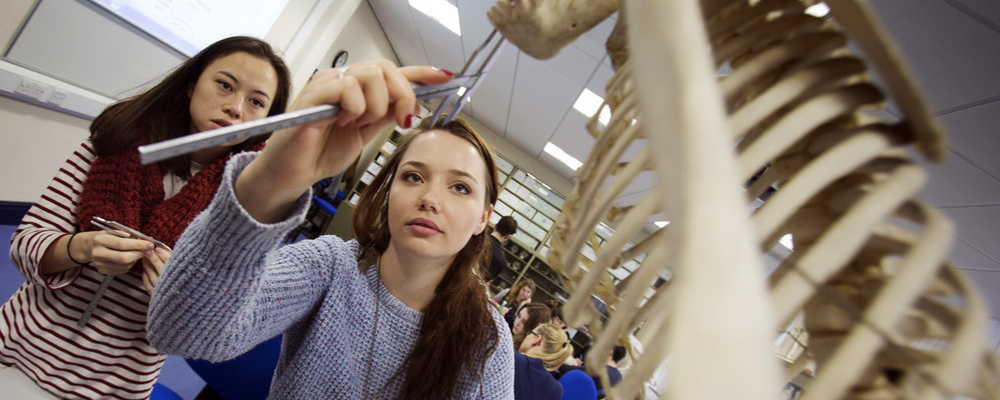
An introduction to palaeoanthropology, examining human anatomy and human origins through a detailed survey of the fossil evidence used to reconstruct the evolutionary history of our own species.

Families in the Social Order

This module explores cross-cultural diversity in the organization of family life and kin relationships, comparing women's and men's experiences, activities, resources, powers, and symbolic significance, and how the cross-cultural perspective of anthropology can reveal new or controversial family arrangements in Western and non-Western societies.

Plus two modules offered by other departments.

Year 2

Biology, Culture and Society

An introduction to the complex interrelations of biology, behaviour and culture and the challenges of studying these interactions, from Darwin’s theory of evolution to human genetics to evolutionary influences on behaviour and cultural evolution.

Evolutionary Anthropology

This module explains how evolutionary processes produce diversity in behaviour and anatomy, with a particular emphasis on primate (including human) evolution, covering natural selection, sexual selection, primate socio-ecology, and behavioural and cognitive evolution.

Human Ecology, Genetics and Health

Examines human health and disease within an ecological framework, exploring the interactions of environmental, genetic, physiological, and cultural factors in the expression and distribution of human diseases.

Kinship and Belief Systems

Explores how kinship and belief studies inform us about other societies and our own, across different environments and evolving futures, examining the cultural nature of basic beliefs and values manifested in both simple and complex societies.

Political and Economic Organisation

Explores how labour shapes identity and citizenship, global networks of power, inequality and displacement, and how the consumption, production, and circulation of goods become invested with personal and collective meanings.

Methods and Explanations

Provides a grounding in research methods in both social and biological anthropology, looking at the relationship between data and anthropological theory, and giving students experience of collecting and analysing data.

Year 3

Dissertation

A double module in which students are supervised by a single member of staff of their choice in an area of their own interest. Students conduct an original piece of research written up as a dissertation, acquiring key writing, presentation and research skills.

Other optional modules from:

Current Issues in Sociocultural Anthropology
Business Anthropology
Paleoanthropology
Material Culture
Nutritional and Disease Ecology
Change and Development
Social Evolution
Violence and Memory
Understanding Behaviour
Mental Health Illness and Drug Use
Environmental Anthropology
Power and Governance
Anthropological Perspectives on Science and Biotechnology
History of the Body
or modules from other departments

If you would like further information please contact anthropology@durham.ac.uk.

Mothers’ Hard Work Pays Off with Big Brains for Their Babies

Brain growth in babies is linked to the amount of time and energy mothers 'invest', according to new research by the Anthropology department.

Admissions Queries

For further information on any of our UG programmes please contact Nicola Hamilton

Mandrill makes 'pedicure' tool

Watch Dr Jan De Ruiter dicuss how monkeys may be more intelligent than previously thought on ITV Tyne Tees.