
SWIFT at ISC19
very exciting … in a few hours I’ll be presenting the SWIFT simulation code and its advanced features at the…
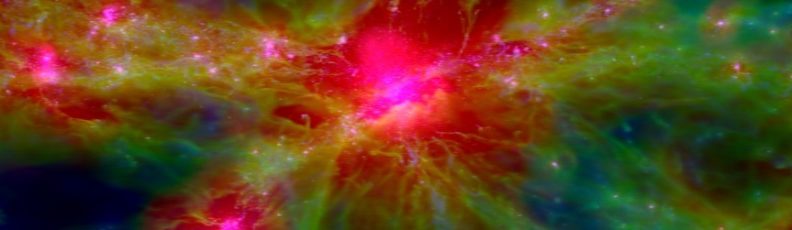
very exciting … in a few hours I’ll be presenting the SWIFT simulation code and its advanced features at the…
In my recent papers (lead by Jaime Salcido and Luke Barnes), we used the simulation code to explore the multiverse! Specifically, we…
At the weekend I’ll be demonstrating some of my group’s work at the Kosmica event. It’s an exciting collision of art and…
Cosmoscope is a sculpture by Simeon Nelson that captures the scales of the cosmos. Simeon worked with a team of…
I’m involved with the opening of a new exhibition on Time Machines at the Palace Green Library in Durham. You…
This year I have two PhD positions available. One is focussed on understanding galaxy formation (funded by STFC), the second…
I’m giving a talk at the Cafe Scientific – its held at Durham’s Empty Shop on Saturday 29th October, starting at 3.45.…
I’m giving a talk on the origin of the Universe on Saturday (15th October)… and after coffee we’ll be playing…
I’ve just submitted a new paper to MNRAS, the professional journal of astronomy… its all about black holes and how they…
It’s great – a while ago I had the opportunity to teach a course on Physics and Motorsport. It was a…