Cape Mountain Zebra Conservation

Cape
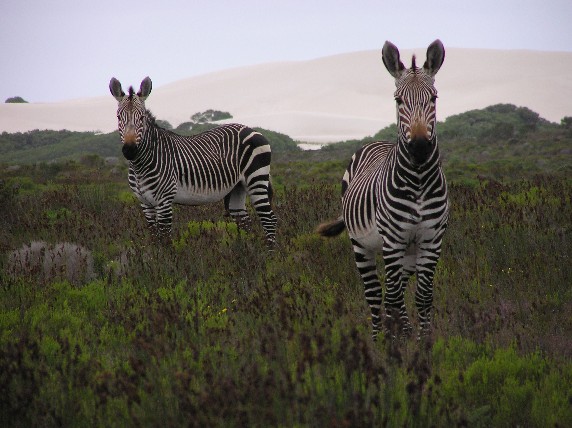
mountain zebra (Equus zebra zebra) once had a distribution
running southward across the mountainous terrain of the Roggeveld
Mountains, the Ceder Mountains and up to the Amatolas. As a result
of hunting and competition with farmers for grazing, however, they
were driven to the verge of extinction such that by 1950, fewer
than 100 members of this species survived. The only original natural
populations remaining are in the Mountain Zebra National Park and
in the Kammanassie and Gamkaberg Nature Reserves. Fortunately, thanks
to focused conservation initiatives, involving resettling of animals
into private and national nature reserves, the numbers in 2000 stood
close to 1200. Despite this success, however, there is much work
still to be done and we are currently engaged in a project aimed
at ensuring the long-term survival of this species.

Capacity
building in mammal management for
Western
Cape nature reserves
In
October 2004 we initiated a project entitled 'Capacity building
in mammal management for Western Cape nature reserves' funded
by the Darwin Initiative. The project has four primary objectives:
|
|
i)
Re-establish long-term monitoring of endangered Cape mountain
zebra (IUCN Endangered, CITES Appendix I) at De Hoop Provincial
Nature Reserve, and establish monitoring at Kammanassie Provincial
Nature Reserve and Gamkaberg Provincial Nature Reserve, in
line with IUCN (2002) recommendations for successful management
of small populations. |
|
|
ii)
Develop a rigorous methodology for monitoring of flagship
threatened mammal species using icon-driven handheld computer
technology suitable for semi-literate to illiterate conservation
field staff. |
|
|
iii)
Develop clear large mammal census techniques for Western Cape
provincial nature reserves for new management policy of current
reserves and to develop capacity for planned development of
mega-reserves and reintroductions. |
|
|
iv)
Integrate outputs of established monitoring into a comprehensive
database to facilitate local and regional assessment of
long-term trends and local stability of populations of
target species.
|
Traditionally,
the Western Cape has been a region in which the majority of conservation
efforts have been directed at preserving the unique local flora;
the Cape Floral Region is home to a diverse and sensitive flora
of which has large numbers of locally endemic and globally threatened
plant species. Large mammals are relatively rare in CapeNature
reserves and as a consequence, large mammal censuses are not currently
a feature of CapeNature policy. Nevertheless, the Western Cape
is home to a number of rare mammal species, including Cape mountain
zebra, such that the capacity for long-term monitoring is essential
in developing future management programs. Planned reintroductions
of large native fauna into WCNCB reserves (including flagship
species such as black rhino) have highlighted the need to build
local capacity and methodology for sustainable mammal censusing
as part of a sound management strategy. Over the last few years
we have been working towards implementing a sustainable census
methodology for Cape mountain zebra at De
Hoop Nature Reserve. De Hoop is itself a high biodiversity
priority since its limestone fynbos is a hotspot of endemic richness.
We are currently expanding this censusing to Kammanassie
and Gamkaberg
Nature Reserves, the two remaining natural populations managed
by CapeNature.

The
project uses computer software produced by CyberTracker
Conservation in South Africa. The software is specifically designed
to allow non-literate users to gather large quantities of geo-referenced
data from field observations for projects that range from intensive
monitoring of endangered species to large-scale regional programs
and long-term monitoring of ecosystems. We are working with CyberTracker
Conservation to develop the software to meet monitoring and management
requirements in Western Cape Nature Reserves. Through assessing
the suitability of CyberTracker within the framework of monitoring
the Cape mountain zebra population at De Hoop, the study is developing
the capacity for sustainable management of Western Cape large mammal
populations.
How
does the project work?
See
the field rangers in action!

Smith,
R.K., Ryan, E., Morley, E. & Hill, R.A. (in press)
Resolving management conflicts: could agricultural land provide
the answer for an endangered species in a habitat classified
as a World Heritage Site? Environmental Conservation
doi:10.1017/S0376892911000105
Hill,
R.A. (2009) Is isolation the major genetic concern
for endangered equids? Animal Conservation
12: 518-519
(pdf)
Smith,
R.K., Marais, A., Chadwick, P., Lloyd, P.H.& Hill, R.A.
(2008) Monitoring and management of the endangered Cape mountain
zebra Equus zebra zebra in the Western Cape, South Africa.
African Journal of Ecology, 46: 207-213 (pdf)
Project
Staff:
Dr
Russell Hill - Durham University (Project Leader) (email)
Dr Rebecca Smith - Durham University (Project Officer)
Peter Lloyd - CapeNature (Specialist Scientist - Cape mountain
zebra)
Dr Helen De Klerk - CapeNature (GIS Scientist)
Andrew Turner - CapeNature (Biodiversity Database Manager)
Louis Liebenberg - CypberTracker
Emma Ryan - Research Assistant
Emma Morley - Research Assistant
|