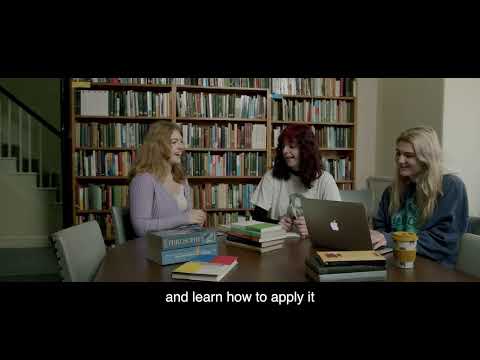
Taught MA in Philosophy at Durham
Why study for an MA in Philosophy?
Some students take an MA in philosophy as preparation for PhD study. Others simply want one more year studying philosophy before moving on to something quite different. Either way, taking an MA in philosophy will give you an opportunity to explore some of the deepest and most interesting questions concerning the world and our place in it. What is more, it will equip you with the analytic skills and critical acumen which are so valued by today's employers.
Why Durham?
Situated in the centre of a stunningly beautiful, historic city, Durham's Department of Philosophy has a thriving postgraduate community, one of the largest in Britain. We do everything we can to provide a welcoming, supportive, friendly and stimulating research environment for all our postgraduate students, and we encourage them to participate fully in the life of the Department. Masters students regularly attend our various reading groups, research seminars, Royal Institute of Philosophy Lectures and the weekly meetings of EIDOS, our postgraduate philosophy society.
Our Taught Masters will enable you to broaden and deepen your understanding of philosophy. In terms of breadth, Durham's Department of Philosophy is exceptional. We have an unusually wide range of interests and expertise, and as a result you will have a chance to study a broad range of topics, from moral philosophy to phenomenology, from Buddhist philosophy to the philosophy of science, and from metaphysics to the philosophy of language. Furthermore, you will have an opportunity to work with internationally recognized experts in these fields, engaging with debates at the cutting edge of research.
All modules are taught through seven group seminars and up to four one-to-one tutorials. For each module, you are required to submit a 2000 word formative assignment and then a 5000 word summative essay.
What will I study?
-
A Philosophical Research Methods Module (30 credits)
-
Three Topic Modules (30 credits each), chosen from the following list of 14 optional modules:
- Ancient Philosophers on Necessity, Fate and Free Will (taught in the Department of Classics and Ancient History)
- Ancient Philosophers on Origins (taught in the Department of Classics and Ancient History)
- Business Ethics (candidates must take both Ethical Leadership and Society and Sustainability for this module)
- Current Issues in Aesthetics and Theory of Art
- Current Issues in Ethics
- Current Issues in Metaphysics
- Ethics of Archaeology and Cultural Heritage (forthcoming 2013-14)
- Gender Theory and Feminist Philosophy
- Mind and Action
- Phenomenology and the Sciences of Mind
- Philosophy and Religion
- Ethics, Medicine and History (also associated with History & Philosophy of Science MA)
- Philosophical Issues in Science and Medicine (also associated with History & Philosophy of Science MA)
- Science and the Enlightenment (also associated with History & Philosophy of Science MA)
- Philosophy of the Social Sciences (forthcoming 2013-14)
- Or a relevant MA module offered by another department.
3. A Dissertation (60 credits)
All modules are taught via group seminars and one-to-one tutorials. There is also a weekly work-in-progress seminar, and a two-day conference, run towards the end of the programme, in which students discuss their plans for their dissertations.
We normally expect you to have a good honours degree (at least a 2.i), or its equivalent, from a recognised university, with philosophy as a major component. Candidates who do not meet these criteria but who would nonetheless like to study philosophy at postgraduate level should take a conversion course before applying to join the MA, and our Diploma course is designed for just this purpose.
We welcome applications from overseas students. Because instruction is in English, you will need to be proficient in written and spoken English. We typically look for our applicants to have achieved an overall band score of at least 7.0 in the IELTS test (with no element below 6.5) or at least 102 in the TOEFL iBT (Internet Based Test) (with no element under 25). In all cases the relevant certificate should have been issued within two years of the programme start date.
You can study on a full-time (one-year) or part-time (two-year) basis. If you choose the full-time option, the programme runs from 1st October until mid September.
For further information regarding employability and fees etc, please follow this link
Further Information
For further information please feel free to contact our Acting Course Director, or view this year's MA Handbook via the link below:
Dr Benedict Smith
Department of Philosophy
Durham University
50 Old Elvet
Durham
DH1 3HN
UK
Mr Jonathon Gilderoy
Department of Philosophy
Durham University
50 Old Elvet
Durham
DH1 3HN
UK
| Degree | Timescale |
|---|---|
| MA | 1 yr FT / 2 yrs PT |
- Philosophy MA Handbook 2012 (last modified: 14 September 2012)

Durham Research Community
Durham University has specialists in many areas of philosophy. If you would like to work with world-leading academics in an area which fascinates you, please have a look through our postgraduate degree programs here.