Cookies

We use cookies to ensure that we give you the best experience on our website. You can change your cookie settings at any time. Otherwise, we'll assume you're OK to continue.

Department of Earth Sciences

Courses

Entry quota: Durham 80DegreeUCAS codeLengthTypical offerCampus
Geology BSc (Hons) F600 3 yrs AAA Durham
Geoscience MSci (Hons) F642 4 yrs AAA Durham
Earth Sciences BSc (Hons) F641 3 yrs AAA Durham
Environmental Geosciences BSc (Hons) F630 3 yrs AAA Durham
Geophysics with Geology BSc (Hons) F662 3 yrs AAA Durham
Geology with Foundation BSc F602 4 yrs Durham
Joint Honours Earth Sciences and Biology, Archaeology, Astronomy, Chemistry, Geography, Mathematics, Physics BSc (Hons) CFG0 3 yrs A*AA Durham
Natural Sciences BSc (Hons) CFG0 3 yrs A*AA Durham
Natural Sciences MSci (Hons) FGC0 4 yrs A*AA Durham

The above standard entry grades are effective for the 2012-2013 admissions cycle.

Flexibility


The degree schemes offered by the department are intended to give students as much flexibility as possible, while retaining the core Earth Sciences subjects. The degrees are run on a modular basis, so that you will be able to choose from a list of subjects each year. This allows you to follow your own interests, as they develop. You should note the following:
  • All students (except the Geophysics option) study the same subjects in the first year, allowing you to swtich degree options, in the second year, if you so wish. So for example if you choose the Geology degree F600 and find after the first year that you would prefer the Environmental Geosciences degree F630, then you will be able to switch.
  • Students who have been accepted on the B.Sc. degree programmes can choose to transfer to the 4-year M.Sci degree programme at the end of their second year. (This will depend on your progress in the first two years.)

Course content

Earth Sciences encompasses the scientific study of the Earth, its origin, its structure and its composition. It includes:

> the dynamic processes that have governed Earth history

> the forces that create mountains, rivers and deserts

> the causes of earthquakes and volcanoes

> the location of oil, gas and minerals

> the environment and its management.

Earth scientists use highly sophisticated technical equipment, as well as the plain and simple hammer, for surveying, sampling and analytical study. We also use computer-based applications for data processing, modelling and interpretation. In other words, a geological scientist is someone who has a broad range of skills which are also appropriate for many other applications.

Our studies take us up mountains, under the ground and into the depths of the oceans. A few geologists have even been into space, although the majority will simply use photographs or other remote sensing images collected using satellites. If you share the growing world-wide concern about the future of the planet and the need to understand, conserve and exploit resources, Earth Sciences is an ideal subject for you. It will equip you with a general scientific education, as well as an in-depth knowledge of this planet, which will have applications in many other fields.

We offer seven degree paths involving Earth Sciences:

> BSc Honours in Geology

> BSc Honours in Earth Sciences

> BSc Honours in Environmental Geoscience

> BSc Honours in Geophysics with Geology

> MSci Honours in Geosciences

> A Joint Honours degree in Earth Sciences under the Natural Sciences programme

> A component in the broad-based degree in Natural Sciences.

Our courses are structured on a modular basis and offer:

> An introduction to Earth processes, crystallography, mineralogy, petrology, stratigraphy, palaeontology, map construction, oceanography and the environment at Level 1.

> A choice of modules at all levels, with the chance to specialise in certain research areas at Level 3.

> The option to undertake a five-week field mapping project or 2-week geophysical survey during the Level 2 summer vacation.

> Options to combine Earth Sciences modules in a Joint Honours degree under the Natural Sciences programme with, for example, Biological Sciences, Chemistry, Geography, Mathematics and Physics.

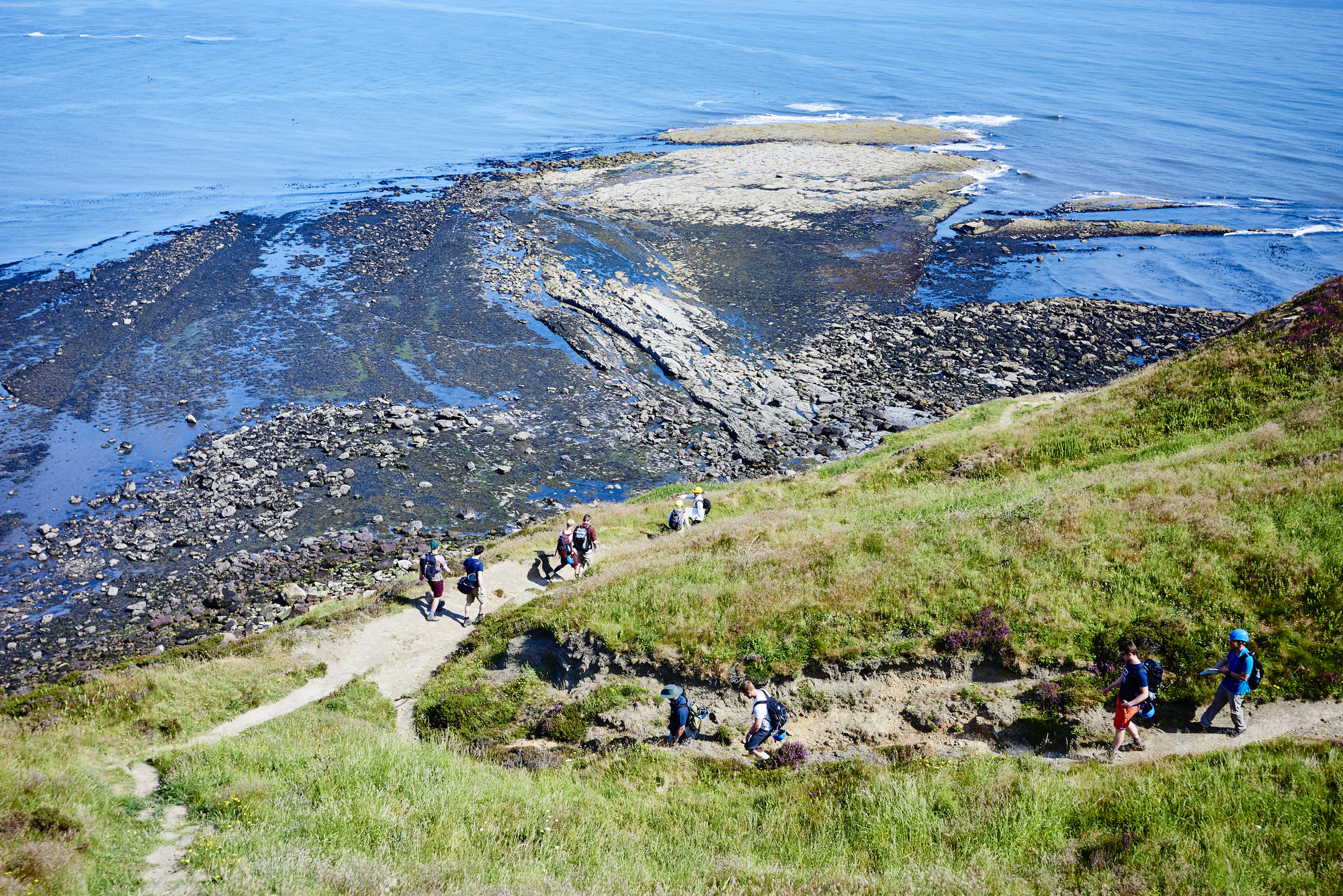
> Fieldwork amounting to approximately 80 days over a three-year course, with studies at selected sites around Britain and abroad, depending upon the degree programme followed.

Order a prospectus

Durham University's Undergraduate Prospectus for 2014 entry now available to order.

Find a course that's right for you

Why not look at the range of courses available